
Spell the Month in Books is a linkup hosted by Jana on Reviews From the Stacks on the first Saturday of each month. The goal is to spell the current month with the first letter of book titles, excluding articles such as ‘the’ and ‘a’ as needed. That’s all there is to it! Some months there are optional theme challenges, such as “books with an orange cover” or books of a particular genre, but for the most part, any book you want to use is fair game!
The options this month are Pi Day, March Madness or Green Covers. I know very little about the first two options and although earlier this month I posted a Top Ten Tuesday post on books with green covers (in honour of St. Patrick’s Day , here are five more books with green covers, all crime fiction novels that I’ve read. The descriptions in italics are taken either from Amazon UK or from Goodreads.
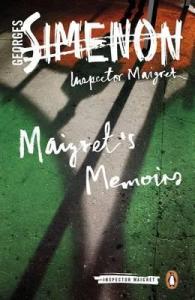
M is for Maigret’s Memoirs by Georges Simenon
This is a fictional autobiography by Georges Simenon writing as Maigret, beginning in 1927 or 1928 when Maigret and Simenon, calling himself Georges Sim, first ‘met’. Maigret looks back to his first ‘meeting’ with Sim. He fills in some of the background of his early life and talks about his father and how he first met his wife, Louise. Simenon had written 34 Maigret novels before this one and Maigret took this opportunity to correct some of Simenon’s inaccuracies.
Simenon drops facts and information piecemeal in his Maigret books and one thing I particularly like in Maigret’s Memoirs is that it is all about Maigret, but I did miss not having a mystery to solve.
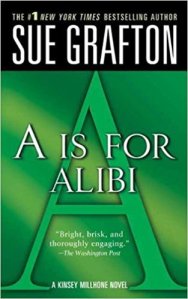
A is for Alibi by Sue Grafton
Set in and around the fictional town of Santa Teresa, California, based on Santa Barbara, where Grafton has a home in the suburb of Montecito, this is the first book in the alphabet- titled series of books featuring Kinsey Millhone, a private investigator. Laurence Fife, a prominent divorce attorney with a reputation for single-minded ruthlessness on behalf of his clients, is murdered. His wife, Nikki was convicted of his murder. On her release eight years later, she hires Kinsey to find out who had really killed him.
It’s a fast-paced book, easy to read and with no gory details.

R is for Rather Be the Devil by Ian Rankin
Some cases never leave you.
For John Rebus, forty years may have passed, but the death of beautiful, promiscuous Maria Turquand still preys on his mind. Murdered in her hotel room on the night a famous rock star and his entourage were staying there, Maria’s killer has never been found.
Meanwhile, the dark heart of Edinburgh remains up for grabs. A young pretender, Darryl Christie, may have staked his claim, but a vicious attack leaves him weakened and vulnerable, and an inquiry into a major money laundering scheme threatens his position. Has old-time crime boss Big Ger Cafferty really given up the ghost, or is he biding his time until Edinburgh is once more ripe for the picking?

In a tale of twisted power, deep-rooted corruption and bitter rivalries, Rather Be the Devil showcases Rankin and Rebus at their unstoppable best.
C is for The Case of the Howling Dog by Erle Stanley Gardner
A dog howled by night in the quiet of Milpas Drive, and drove Arthur Cartright crazy with terror. He begged lawyer Perry Mason to bring a warrant against its owner, who, he said, had taught the dog to howl in order to drive him mad. According to superstition the howling meant a death in the neighbourhood, and Cartright appeared to believe it.
But Mason believed that a deeper fear than superstition was impelling his client and when both the dog and its owner were killed he took up the challenge and set himself to find the murderer.
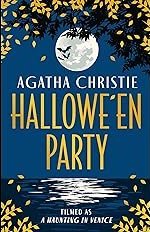
H is for Hallowe’en Party by Agatha Christie
This begins with the party given by Mrs Drake for teenagers. One of the guests, Joyce Reynolds, a boastful thirteen-year old, who likes to draw attention to herself, announces that once she’d witnessed a murder. It seems nobody believed her and yet later on she is found dead, drowned in the tub used for the bobbing for apples game – someone had believed her and had killed her. Mrs Ariadne Oliver was at the party and she asks Poirot to help in finding the murderer.
The next link up will be on April 4, 2025 when the theme will be: Easter OR Pastel Covers
























 BooksPlease