A Walk Along The River Till

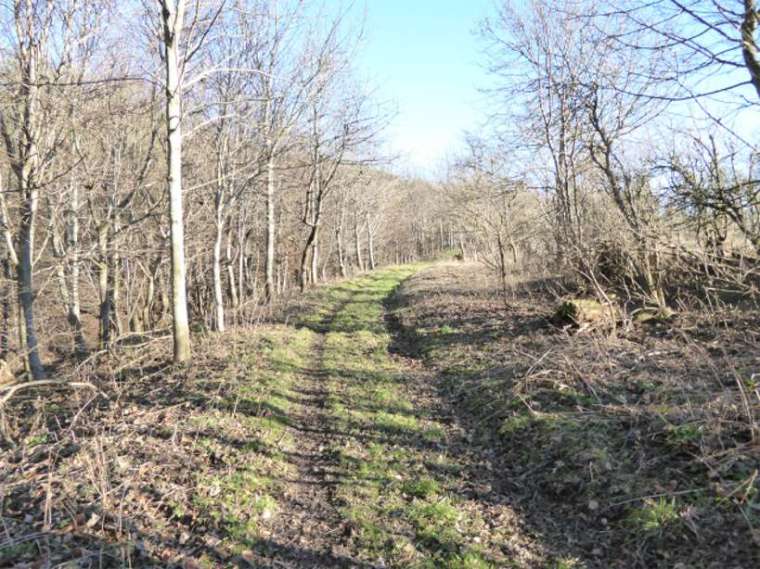
The other day D and I went for a walk by the River Till. From where we parked the car the path ascends above the river along a tree-lined path. 

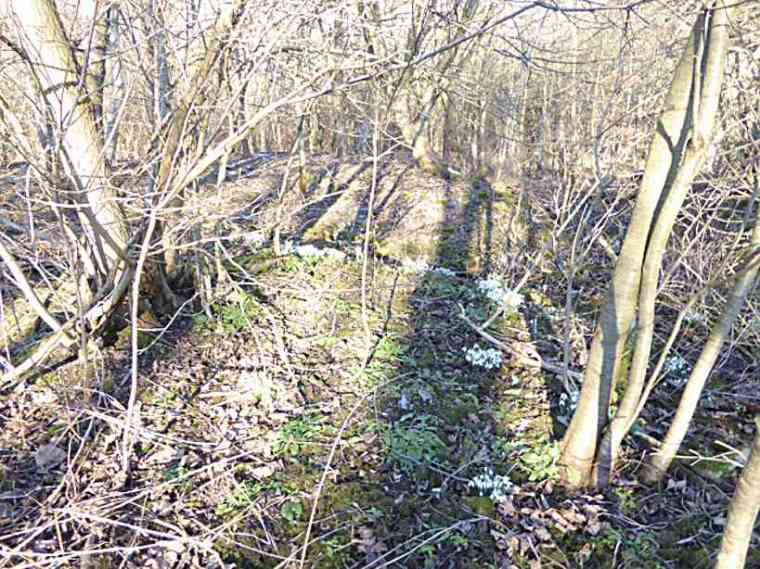
The remains of an old chapel, St Mary’s Chapel are just below the path – only the outline of the chapel and a cross can be seen.

D recorded the route on his iPhone – this extract below shows the position of the chapel.

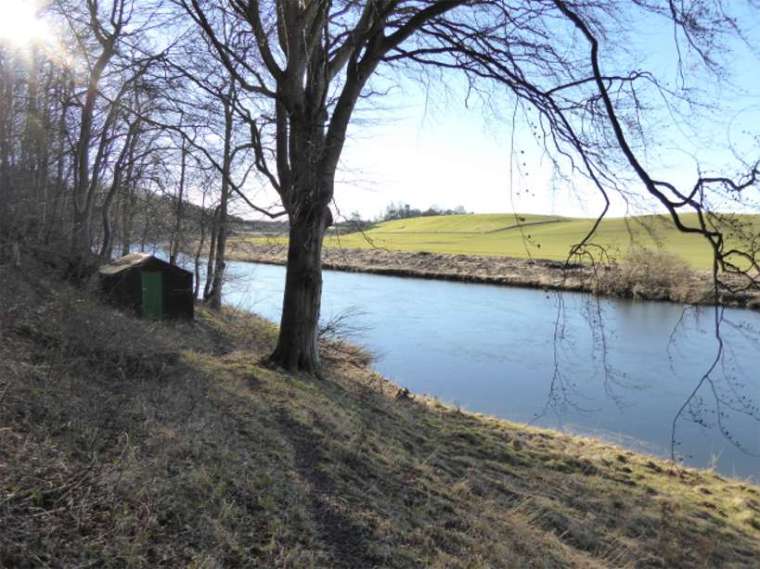
The path gradually descends to the river side.


Then we spied a heron motionless on the opposite bank.

It saw us too and flew away. Then I spotted it in the river.

Again we were seen and it flew away. I just pointed the camera and hoped to capture it flying – you can just see it over the water

 and landing on the bank further upstream.

We continued our walk along the riverbank, meeting a group of cyclists struggling to ride on the stony surface (the route is Sustrans 68).

After a rest on this seat we turned round and walked back.

A Winter Walk

We had a break in the snow this afternoon, the sun came out, the sky was blue so we ventured out for a walk across the road into the fields alongside a wood and then down to the river.

In the garden at the start of our walk


Field edge path
Field edge path
View across the field

 We climbed over a ladder stile and then went down a narrow path towards the River Tweed

Path above the River Tweed

 and then looked down on the ice flows on the river.

River Tweed
River Tweed

The views were spectacular.

Sun going down on the River Tweed

Then the sky darkened and snow began to fall and so we made our way back home through the woods.

Into the wood
Into the wood


Woodland path
Woodland path

 For more photos see Flickr.


A Saturday Stroll – Saturday Scenes

On such a beautiful sunny day, even reading The Madonna of the Rocks by Marina Fiorato (her new book due out in May) couldn’t keep me indoors, so D and I went out for a walk. Although it’s still only February it feels and looks as though spring is here. We went down a narrow uneven footpath near opposite our house to an old country lane and then across fields to the edge of a lake.

path-by-wall1


There were plenty of birds, including this heron perched on a fence in the distance.

heron2

And a swan:

swan

As we continued on our walk overhead a red kite soared above the trees, chased away by the rooks making a terrific racket. The path home is over more fields rather wet and boggy after the wet weather and snow.

wet-path

The cattle were also noisy, waiting to be let out into the fields.

cattle1

Back over the fields. This is a well-used path but today we only passed one other walker.

field-path

Signs of spring along the way – snowdrops

snowdrops2


and croscuses.

snowdropscrocus


crocus1


Home with muddy boots.

boots

Just a Glimpse of the Orient


On Monday D and I went for a walk with a friend alongside the Wendover Arm of the Grand Union Canal. It was a beautiful, sunny day and we enjoyed these views. This is the start of our walk.

The Wendover Arm was first constructed in 1797, but as sections of it leaked it was “de-watered”. From 1989 onwards it has been restored and this is what it looks like today.

Kingfishers can be seen along the canal, but we didn’t see any on Monday. There were lots of other birds though, ducks, moorhens, coots and dabchicks (otherwise known as little grebes), busy diving and collecting nest material.


The ducks were in fine form, taking off a high speed and then landing with legs flailing before splash-down.

Further along the canal we saw a swan sitting on a large nest over on the other side.

The canal opens up into an area known as the Wides, with areas of grass and shrubs with a tiny island on the far side. Trees have invaded what was once open water and without management the canal would disappear in a few years.

Then came a surprise – a pair of mandarin ducks. I’d never seen these before; they looked very different from the other birds on the canal, but just so beautiful. The male has very distinctive chestnut brown and orange fan wings sticking up above his body, whilst the female is a duller brown with white spots. They were swimming together in and out of the trees. When I came home I looked them up in our bird books. Originally from China these ducks like streams and overgrown lakesides in broad leaved woodland and they nest in tree cavities. The canal is the perfect place for them.

A Country Walk on Public Rights of Way

Being a bookaholic means that I spend a lot of time inside, as I don’t really like reading outside even on sunny, warm days. But I do love walking and maps. Although we haven’t got nearly as many maps as books we do have quite a large collection of maps because every time we go to a new place we buy a map and explore the countryside and towns. The photo shows a small selection of our maps.

I’ve been meaning to write about walking since I started this blog. England is criss-crossed by many, many miles of public rights of way and my husband and I spent many years working as rights of way officers dealing with the maps, landowners, walkers, horse riders and cyclists, and not forgetting the trail riders. We love walking, although now we don’t walk as much as we used to do. We went for a walk today and although the sun wasn’t shining it was a perfect autumn day. The trees are just turning bronze, yellow and gold and the views were beautiful. The fields have been ploughed and the new crops are just showing through. It was so peaceful; we were alone in the countryside, apart from the birds, cattle and sheep and not another soul in sight.

These are some of the views from our walk.


When we go out walking we can’t help looking at things from a Rights of Way point of view. The public footpaths are all open and easy to use, but the photograph below is a good example of what I mean. It should have been marked out at least 1 metre wide by the farmer as it is a cross-field path. But it’s really narrow and because it’s only been walked out through the crop by people using the path it is only just wide enough to walk along in single file. Anyway, as we’re retired now we just moan about it to each other and carry on – it’s still walkable after all. We can’t help noticing when paths are not quite in the right position either and that’s another little gripe.

There were cattle in the next field. They weren’t the slightest bit interested in us and carried on munching the grass as we walked by.

Further on our walk we left the fields and continued down a little enclosed path, the ground covered in fallen leaves.

This led to a another narrow footpath fenced in between two fields – sheep in one and more cattle in the other. Looking at old maps I can see that it was originally an unfenced path across a larger field. At some time after 1930 the field was divided in two and the path enclosed between the two fences.

This is an awkward path to walk along as it is on a slope and is stepped, one side being slightly higher than the other and is uneven – you have to watch where you put your feet. But I’m just being picky now, it’s not hard to walk along and many people use it every day with little difficulty.


As we walked along the cattle ignored us but the sheep were very interested and came to see us.


This Land is Our Land by Marion Shoard is about the history of the British countryside and has some interesting information about the origins of public rights of way. Now the Countryside and Rights of Way Act 2000 has made more areas of the countryside open for public access, but rights of way still provide the main access available for the public to use.

Good places to find information on public rights of way are Defra and the Ramblers’s Association. The Ordnance Survey publishes a series of Pathfinder Guides for walks in the British Isles. They’re excellent and give details of walks of varying lengths and difficulty ranging from gentle strolls to quite challenging routes over rugged terrain.

Cotswolds Break – Minster Lovell

We’re in the Cotswolds again for the third time this year – we like it. Today we walked from Minster Lovell, a beautiful little village through the fields alongside the River Windrush to the ruins of Minster Lovell Hall.

We did get our feet wet as the path was still flooded in parts.

After this section the path left the river and we climbed up through woodland to fields, eventually reaching Crawley, where we stopped for a drink at the Lamb Inn, still with wet feet and muddy boots!

Back along the footpaths to Minster Lovell church.

Lancashire Landscape

Last weekend we went to stay with friends in Helmshore, Lancashire, just north of where we all grew up together in Cheshire. It was a long time since we’d got together, so there was a lot to catch up on. Lancashire is not just large industrial cities but also has some beautiful countryside, as these photos show.

The weather was fine last Saturday afternoon when we took Silka for a walk around Calf Hey Reservoir, one of several reservoirs near Helmshore, in the West Pennine Moors.

Moorland is now Open Access Land thanks to the Countryside and Rights of Way Act 2000, meaning you can walk anywhere, but we stuck to the footpaths.

From here we could see Ogden Reservoir on the right of Calf Hey.
Calf Hey Reservoir was constructed in 1854, flooding what was previously farmland. The remains of several buildings, dating from the 17th century are still there next to the reservoir. There were originally a number of cottages and a substantial house. By the 18th and 19th centuries the cottages were used for handloom weaving, which were gradually superseded by the powerlooms of Calf Hey Mill. The Bury and Radcliffe Waterworks Company, who owned the land, terminated the leases on the cottages and farms to prevent contamiantion of the water supply and the Mill closed. With no employment this led to the abandment of the village and farms between 1890 and 1920.

Sunday morning was also fine and sunny and we did a circular walk from our friends’ house, walking alongside a stream for most of the way, then through the little village of Irwell Vale and back home.

The white blobs on the trees in the middle of the photo below are actually herons (we forgot to take the zoom lens).

It rained in the afternoon when we visited Clitheroe and Waddow Hall, where my friend and I had first camped with the Girl Guides when we were 11.

It hadn’t changed much!

This is the weir at Waddow, still looking just as I remembered it.

On the way back we drove past Pendle Hill shrouded in mist, which reminded me of Robert Neill’s Mist Over Pendle, a story of witchcraft in the 17th century. I found my copy when I came back home. “If a hill could have an indwelling Spirit, then surely this had one – and it might not be the friendliest of Spirits.There was some brooding quality about this hill, as though it were sentient and knew more than it chose to tell. … This hill seemed different from other hills, as though it possessed something – or even, perhaps, as though something possessed it.”

In the mist and rain last Sunday I could imagine how the hill drew people’s imagination. The weather was too bad to take a photo, but this is from Wikipedia, showing the hill on a fine day.

Bluebell Walk

Sunday was sunny, perfect for a Bluebell Walk at Rushall Farm. We went with our son and his family and friends to celebrate our grandson’s birthday last week.
The children had a lovely time and enjoyed looking at the chickens, lambs, pigs, cattle, donkeys and of course, the farm machinery. Finally we had tea and cakes in the barn – all in aid of the Multiple Sclerosis Society.