Nocturnes: Five Stories of Music and Nightfall by Kazuo Ishiguro

Nocturnes by Kazuo Ishiguro is a quintet of stories exploring the themes of love, music and the passing of time. All have narrators who are musicians. As I wrote in an earlier post I’m not a great fan of short stories but these are better than most as they do flesh out the characters in more detail, although some of them just seem to stop rather than ending, leaving me wanting more. There’s nothing dramatic here, rather they are gentle stories with a touch of nostalgia and a sense of loss for what has gone or what could have been.

The first story is The Crooner set in Venice. A young Hungarian musician playing in a cafe meets his mother’s favourite singer, the ageing Tony Gardner. Tony enlists the musician’s help in seranading his wife, Lindy from a gondola.  He reminisces, looking back with nostalgia over the 27 years he and Lindy have been married. They rehearse the songs he’s going to sing to her, all the while going round in circles passing the same palazzo several times. By the end of the story I was left feeling sad – things were not what they initally seemed.

I wasn’t quite sure what to make of Come Rain or Shine. Ray goes to stay with his friends Emily and Charlie. Their marriage is obviously going through a bad patch and when he is left alone in their flat bored with reading Mansfield Park and browsing their CD collection he can’t stop himself from reading Emily’s diary. What follows is farcical as in his attempts to hide the fact he read the diary he ends up wrecking the room and pretends that it was the neighbour’s dog.

The Malvern Hills, is another sad story about a young musician who’s struggling to make his way in the rock world. He retreats to the Malvern Hills to compose love songs. There he meets an older couple, Swiss folk singers Sonja and Tilo, whose lives are on the point of change.

Noctune, the title story again features Lindy some years later. She and a saxophonist are neighbours, convalescing in a luxury hotel after they’ve both had plastic surgery. A sad bittersweet story as they listen to CDs and then go on a nocturnal walk around the hotel in the early hours of the morning. But their lives have not lived up to their dreams and a plastic surgeon can’t fix that.

The last story Cellists completes the cycle – back in the same cafe in a piazza in Venice seven years later. Tibor, one of the cellists, meets and falls under the spell of Eloise, an American who is apparently a distinguished musician. Their encounter changes his life for the worse.

These stories are full of longing and regret, something which I think Ishiguro does well.

Tuesday Teaser – The Hound of Death by Agatha Christie

teaser-tuesday

Teaser Tuesday is hosted by MizB at Should Be Reading.

Grab your current read.
Let the book fall open to a random page.
Share with us two (2) “teaser” sentences from that page.

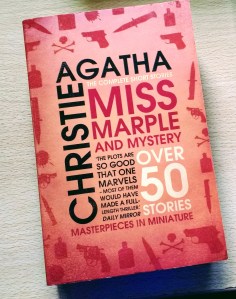
Hound of death The Hound of Death is a book of short stories. Today’s teaser is from the second story, The Red Signal on page 46:

And I will tell you this, if the man suffering from a delusion happened to hold his tongue about it, in all probability we should never be able to distinguish him from a normal individual. The extraordinary sanity of the insane is a most interesting subject.

Good Evening, Mrs Craven by Mollie Panter-Downes

good-eveningThere are 21 short stories in Good Evening Mrs Craven: the War-time Stories of Mollie Panter-Downes. These portray the lives of people on the Home Front, getting on with their lives set against the backdrop of war. They’re not stories of action but their subjects are psychological, emotional and social.  They offer a glimpse into what life was like then – the mood, the atmosphere, the tension and the fear, the hopes and the devastation, the loss and the loneliness, the stress and the tragi-comedy of life.

Mollie Panter-Downes’s style is fluent, a touch journalistic, sometimes subtly ironic and most pleasurable to read. There are stories of housewives, evacuees, billeted soldiers and Home Front volunteers, of the ladies in the Red Cross sewing party who met ‘twice a week to stitch pyjamas, drink a dish of tea, and talk about their menfolk’,  the effects of food rationing, of lovers separated by the war and of ‘The Woman Alone’.

Social changes are highlighted in stories such as ‘Cut Down the Trees’. Forty Canadian soldiers are billeted at Mrs Walsingham’s big house by the river. Her maid, Dossie is horrified by the changes. She mourns the passing of the old way of life, blaming the Canadians:

Of course it wasn’t precisely their fault they were there, but it made her sick to hear their big boots clattering up and down the stairs and to see their trucks standing in line along thelime avenue. (page 150)

She looks forward to the end of the war:

When peace came, sane existence would be immediately resumed. Dossie sincerely believed that the big house, quietly chipping and mouldering above its meadows, would be instantly repopulated, as though by a genie’s wand, with faceless figures in housemaid’s print dresses, in dark-blue livery and gardener’s baize aprons. She believed that the lawns would be velvet again, that visiting royalty would once more point a gracious umbrella towards Mrs Walsingham’s Himalayan poppies, that the gentry would know their places and sit over their claret in the dining room, where they belonged.

In contrast, Mrs Walsingham is more realistic and accepts the inevitable change. When the trees are cut down to make space for the soldiers’  ‘paraphernalia’ she thinks it is an improvement, letting in more air and light. She says

It’s altered the view from this side of the house, but what’s a view? Everything else is changing so fast I suppose we shouldn’t bother about trees and water staying the way they were. (page 153)

Sunday Salon – An Elegy for Easterly by Petina Gappah

Yesterday I finished reading An Elegy for Easterly by Petina Gappah. My copy, via LibraryThing’s Early Reviewer’s Programme, is an uncorrected proof and is not for quotation, so no quotes in this post.

elegy-for-easterly001This book has one of the most attractive covers I’ve seen for a while – the colours as well as the trees receding into infinity.

I sometimes don’t get on very well with collections of short stories but these are long enough for the characters to be more developed and the stories to be more satisfying than others I’ve read. But several I though would be even better developed as full length novels. They are about the lives of people in Zimbabwe, struggling to live with escalating inflation, where a loaf of bread costs half a million dollars, of corruption, scams, disappointed lives, unfulfilled dreams and broken promises. They paint a bleak picture of the resilence and resistance of people in extreme circumstances, coping with despair.

Something Nice From London is one of the most poignant tales. Relatives living in England often sent something special to their families back home but one family are waiting at Harare airport for something different  - the arrival of Peter who died in London.  His cousin, also living in England keeps promising his body will be on the flight. Peter was the golden boy and much was expected of him. This is the story of unfulfilled ambition and expection. Because you’re not allowed to speak ill of the dead, the family have to forget how he bled them dry with constant demands for more money to pay his fees and provide accommodation and food as they mourn his death. Eventually the body does arrive, but not how they expected.

I also enjoyed Our Man in Geneva Wins a Million Euros, the story of a diplomat conned by an internet scam. In At the Sound of the Last Post, a politician’s widow at her husband’s funeral ponders the corrupt society they’re living in as his collegues bury an empty coffin – her husband was not the national hero he was made out to be. Death and sickness figure quite prominently in most of the stories and the book as a whole, although laced through with ironic humour,  is a lament – a lament for  Zimbabwe and its suffering people.

a Leap

a-leap002I received an Advanced Reader’s Copy of a Leap by Anna Enquist, translated by Jeannette K Ringold from LibraryThing Early Reviewer’s Program. It’s a very short book (80 pages), to be published in April 2009, made up of six monologues. Overall they are sad, even tragic stories.

The first one, Alma, was commissioned by the Rotterdam Philharmonic Gergiev Festival and its performance preceded a performance of Gustav Mahler’s Sixth Symphony. I liked the fact that it’s based on historical facts taken from letters and diaries. Alma was Gustav’s wife and she reflects on her life, having given up her own music to support him. It seems he forced her to do so and she is at once repelled and intoxicated by him, but she is torn between her love for him and Alex, a former lover. This is my favourite of the monologues.

The second story, Mendel Bronstein, shocked me. It’s about a Jewish tailor who decides to lter_small_transparentleave Rotterdam in 1912 to make a new life in America. He is desperate not to forget his own language, with disastrous consequences. This story actually made me squirm.

Cato and Leendert, form the interlinked monologues three and four. Set again in Rotterdam in the spring of 1940 they are a pair of young lovers. Cato first waits in the kitchen for Leendert as the bombs drop on the city and then goes out to search for him as the Germans take control. Meanwhile Leendert is still working at the zoo and ordered to kill the dangerous animals, including his favourite lion, Alexander. I thought this was a touching story full of pathos. It was also based on historical sources and together with Mendel Bronstein was written for the production of Lazarus as part of Rotterdam Cultural Capital of Europe in 2001.

The Doctor is a very short monologue also set in Rotterdam during World War II from a doctor who saves the life of a wounded German general. He wonders if he has done the right thing. This was commissioned by the Bonheur theater company in 2005 for the commemoration of the bombing of Rotterdam in 1940.

The final monologue is  …and I am Sara. Sara is alone in her parents house. She is twenty seven and so far her life has not turned out how she wanted. So much has gone wrong, but now it seems life is set to improve but then disaster overtakes her.

In all these stories fate or circumstances take control, no matter how the characters have struggled in their lives. Anna Enquist is a musician, and a pyschoanalyst as well as a poet and novelist. Her writing is clear bringing the people and places to life. I particularly liked the stage directions in first and last monologues and the insights into the characters’ thoughts.

Tales of Terror

The Body Snatcher and Olalla are two short stories by Robert Louis Stevenson included in my copy of The Strange Case of Dr Jekyll and Mr Hyde, a Penguin Classic. Both stories were written for the Christmas “crawler” tradition in 1884 and 1885. Christmas was a season traditionally associated with supernatural and creepy tales. In the introduction to the book, the editor, Robert Mighall explains that a “crawler” was a ‘sensational tale of a supernatural incident designed to produce a pleasurable thrill in its readers.’

The Body Snatcher is very much a traditional Christmas ghost story, beginning with four men gathered in an inn on a dark winter’s night telling tales round the fireside of grisly deeds. On this particular night Fettes, the local drunk, is roused from his stupor  as if “arisen from the dead” when he hears the name ‘Dr Macfalane’. What follows is the tale of their relationship in the past when they were both medical students. The title of this story of course gives the game away and it is based on the activities of Burke and Hare in Edinburgh in the 1820s, body snatchers who turned out to be murderers selling bodies that had never been buried. I didn’t find this story to be very chilling or thrilling, although I didn’t predict the slight twist at the end. The interest for me is in the two personalities of Fettes and Macfarlane and how the turn of events affected their lives. Macfaarlane had gone on to be a successful and wealthy doctor, untroubled by his conscience, and

richly dressed in the finest of broadcloth and whitest of linen, with a great gold watch chain and studs and spectacles of the same precious metal; he wore a broad folded tie , white and speckled with lilac, and he carried on his arm a comfortable driving coat of fur.

Whereas Fettes overcome by his conscience had lived in idleness, pursuing

“crapulous, disreputable vices”. Permanently in a “state of melancholy, alcoholic saturation”, a “parlour sot, bald, dirty, pimpled and robed in his old camlet cloak”.

Olalla is a longer story and to my mind is the better of the two. When does a short story cease to be considered short, I wonder? It is definitely written as a Gothic tale, set in an ancient Spanish castle surrounded by deep woodland, about a young man recovering from his war wounds and to “renew his blood”, who finds himself living with a strange family. The castle is as much a character in this story as the people, fallen into disrepair as much as the family has degenerated from its noble ancestors who fell prey to evil.

The young man, naturally, falls in love with Olalla, the beautiful daughter, with a strange mad mother and a simpleton brother.  She fears she has inherited the evil of her ancestors and the hint of vampirism in her mother. There is almost a fairytale feel to this story with references to Sleeping Beauty locked by magic within the castle, and also a chill factor which Bram Stoker later developed in Dracula.

This completes my reading for the RIP Challenge, although I have several more books that I would like to read such as The Turn of the Screw. Thanks to Carl for hosting the Challenge.

The Sunday Salon – Reader Satisfaction

I’m in the middle of two very different books – Going Into a Dark House, a book of short stories by Jane Gardam and Messenger of Truth, a Maisie Dobbs mystery by Jacqueline Winspear. Both are giving me a lot of reader satisfaction; they take me out of myself and into their worlds, peopled by believable characters, set in realistic locations, and with plots that are detailed and complicated enough to keep me wondering how everything will turn out and hoping for a sequel.

I’ve only recently begun to appreciate short stories and still prefer the longer short stories in preference to those of just a few pages. The plus factor is reading short stories is that you can read one in just one session, making it a complete experience. Going Into a Dark House is a collection of eight short stories, all long enough to satisfy my requirements. The title story, which I haven’t read yet is the longest and is in three parts. Death figures quite a lot in these stories, in different guises and also reflections on age, youth and nostalgia. The first story is Blue Poppies which begins: “My mother died with her hand in the hand of the Duchess.” You know at the start that there is a death; the rest of the story leads up to this death and its effect on the daughter.  I like the way Jane Gardam writes, conjuring such vivid images that it seems as those I’m actually witnessing the scene. For example the blue poppies are

… just like Cadbury’s chocolate papers crumpled up under the tall black trees in a sweep, the exact colour, lying about among their pale hairy leaves in the muddy earth, raindrops scattering them with a papery noise. 

Zoo-Zoo is a strange little tale about a dying nun who is taken by two of her fellow nuns to a nursing home to end her days. She is not as senile as they suppose. My favourite story so far in this collection is Dead Children, which I think is absolutely brilliant. How Jane Gardam can write twelve pages about such a deceptively simple meeting of a mother and her two children and infuse them with such depth of meaning and emotion is just beyond me.  The twist at the end makes an ordinary everyday event amazingly extraordinary.

Messenger of Truth is a much longer book and my reading has been spread out over a few sessions already. It is a detective story set in 1930/1 in England. The artist Nick Bassington-Hope has fallen to his death from the scaffolding whilst installing his work at an art gallery. The police believe it is an accident, but his twin sister Georgina isn’t convinced and hires Maisie Dobbs to investigate his death. Along with Nick’s death there is also the mystery of the missing piece of art work that was to be the centre of the exhibition.

I’m just over half-way through this novel and I think I’m going to have to abandon other books I have on the go in order to finish it. Maisie’s methods of investigation take her to the art gallery, to Dungeness where Nick lived in a converted railway carriage and to visit his family at their home near Tenterden. After questioning his friends and seeing Nick’s paintings she becomes convinced the mystery of his death is related to the missing painting and that this is connected to Nick’s experiences as a war artist during the First World War.

I like the way the mystery is set in the cultural and social setting of this period, between the two World Wars. England is a place where there is a great divide between the wealthy and the poor. Maisie’s assistant Billy Beale is struggling to accept that people have money to spend on artwork when others can’t afford food and medicine. The realities of life are highlighted when Billy’s family catch diphtheria and his two year old baby, Lizzie is taken into hospital. The lingering effects of the war are starkly and shockingly described in Georgina’s reminiscences about the treatment during the war of men suffering from shell-shock.

 Maisie is a an independent woman living on her own, working out her relationship with Andrew Dene, who hoped to marry her. Their relationship is floundering as she is absorbed in her work and doesn’t want to give it up and conform to the accepted role of being a doctor’s wife. She is discontent and is seeking a quality out of life that she cannot quite define. She finds the thrill of investigation outweighs her desire to help others. It is the search for truth that motivates and thrills her.

Both books are immensely satisfying.

A Good Hanging by Ian Rankin


Happy Birthday to Ian Rankin. My choice for the Celebrate the Author Challenge in April is A Good Hanging by Ian Rankin whose birthday is today 28 April.

A Good Hanging is a collection of twelve short stories featuring Inspector John Rebus, set in Edinburgh. All the stories are concise and I think convey the character of Rebus; he is cynical and analytical, a lone worker, who drinks and smokes too much. None of the stories pose complex mysteries and are seemingly easily solved by Rebus. I did enjoy the book but it is less satisfying for me than a full length novel. I have several other Rebus books in line including Black and Blue, which promises to be ‘a first-rate and gripping novel’, according to the Sunday Times.

First published in 1992 it’s one of the earlier Rebus books. The first story in this book is called “Playback”. Rebus is impressed by being able to phone your home phone “from the car-phone” to get “the answering machine to play back any messages.” You can tell from this that it’s rather different from current crime detection fiction. As the title indicates, solving the crime in this story hinges on phone messages. The police receive a phone call from the murderer confessing his crime. He panics and tries to flee, only to be caught as the police arrive on the scene of the crime. He then insists on his innocence. Rebus disentangles the puzzle even though this seems to be “the perfect murder”.

In “The Dean Curse” Rebus is reading Hammett’s novel “The Dain Curse”, which he tosses up into the air disgusted by how far-fetched and melodramatic that book was, piling on coincidence after coincidence “corpse following corpse like something off an assembly line”, when he receives a phone call with news of a car bomb that had just gone off in Edinburgh. He cannot believe it has happened. It seems as though this is the work of terrorists, the bomb having all the hallmarks of an IRA bomb and it had gone off seconds after the car had been stolen. It seems to Rebus as if the coincidences in the Hammett story have nothing on his case. But there is more to this case than at first meets the eye.

My favourite in the book is the title story “A Good Hanging” in which Rebus solves the crime through his knowledge of “Twelfth Night”. It’s set during the Edinburgh Festival period, when the city is full of young people, theatrical people. A Fringe group, comprising a number of students are staging a play called “Scenes from a Hanging” promising a live hanging on stage. The story starts with the discovery of a young man found hanging from the stage scaffold in Parliament Square. It appears to be suicide according to the note in his pocket “Pity it wasn’t Twelfth Night”. Rebus investigates and finds that all is not as it seems.

The other stories involve the discovery of a skeleton buried beneath a concrete floor, a Peeping Tom, and blackmailers. One story I particularly like is “Being Frank” about a tramp who overhears two men talking about a war that’s coming. He is well known for making up stories and informing the police of numerous conspiracies so they just laugh at him. But fearing the end of the world Frank confides in Rebus who eventually begins to suspect that this time Frank is not lying.

I see on Ian Rankin’s website that he has written the final Rebus book Exit Music. Another book to add to the book mountain.

The Sidmouth Letters by Jane Gardam

The Sidmouth Letters is a collection of eleven short stories. It’s a short book of just under 150 pages, so it doesn’t take long to read the whole book. With a collection of short stories I tend not to read from the start to the end, picking and choosing which ones to read, but with this one I read the stories in the order they are in the book. I was glad I did as I think the last one is the best. The stories are nicely varied in style and content with convincing and authentic characters. I liked some more than others.

The first story is “The Tribute”, a perceptive and amusing study of a trio of Kensington widows exposing their small-minded attitude to a former nanny, when they receive news of her death.

I wasn’t too keen on “Lychees for Tone”. It is written in the present tense, which I find irritating. A lonely mother lives with her son. As she waits for him to bring home a new girlfriend she ponders what she will be like and her isolation and prejudices become apparent. I thought the ending was disappointing with a predictable play on words.

“The Great, Grand, Soap-Water Kick” is a story about a tramp, Horsa looking for a house in which he can have a bath, which only happens every second year or so. You can imagine the state he is in and the state of the house by the time he has finished. I liked the idea and the structure of the story. Although I liked the imagery and the style of writing does reflect the character, I found it jarring and disjointed. But then I don’t think you’re actually meant to like Horsa.

“Up steps smelly Horsa.
Rings bell no answer.
Ringsgain no answer.
Ringsgainturns look updown. Not living soul. Not motor car. Not bike. Only cat gatepost watch through yellow slits. Cat stands, stretches on four fat sixpences, turns round, curls upgain, goes sleep.”

In “Hetty Sleeping” a married woman on holiday with her two children meets a former lover, and wonders what her life could have been like.

In “Transit Passengers” two young students are leaving Greece and go their separate ways. Will their love survive, or is it as transitory as their journey?

“The Dickies” are a married couple. Mrs Dickie is neurotic and has to suffer her husband’s infidelities. All is not as it seems, however.

I particularly liked “A Spot of Gothic”. A young army wife living in the remote countryside is driving home alone late one night when she encounters a woman standing in her garden waving to her. It’s the loneliest part of the road and she is shaken and frightened at the sight. She wonders if she saw a ghost. When she returns to the road the next day she feels she is being watched and sees a woman who asks her the time and walks away, leaving the young wife feeling terrified: “The dreadful sense of loss, the melancholy, were so thick in the air that there was almost a smell, a sick smell of them.” Who has she seen?

The last story “The Sidmouth Letters” deals imaginatively with Jane Austen’s love life. Annie meets a former professor who had claimed credit for her work when she was a student. He has discovered that love letters, supposedly written by Jane Austen have been found and he sends Annie off to Sidmouth with instructions to buy the letters. The story reveals how Annie gets her own back on the professor. The question is – did Jane Austen write the Sidmouth letters? This story was the reason that I read the book and it didn’t disappoint.

Ladies of Grace Adieu by Susanna Clarke and illustrated by Charles Vess


I started the R.I.P. Challenge II aiming to read just one book. It’s now nearly the end of the challenge and I have exceeded my target. I have read Ghostwalk by Rebecca Stott, several short stories from Edgar Allen Poe’s Tales of Mystery and Imagination, from the Great Ghost Stories collection published by the Chancellor Press and today I finished reading The Ladies of Grace Adieu and Other Stories by Susanna Clarke. I’m glad I took this challenge as it has made me read Poe’s Tales after years of wondering what they are like, but I am a little disappointed that they are not as spooky as I imagined them to be and I don’t like the gory elements and Poe’s fascination with premature burials. I’m probably in a minority on this.

Ghostwalk was to my mind a much more satisfying read and I’m pleased that The Ladies of Grace and Adieu was as fantastical as Jonathan Strange and Mr Norrell (also by Susanna Clarke), which I read about two years ago. I was entranced by Jonathan Strange and Mr Norrell, which is set in a parallel nineteenth century England and tells the story of two magicians, full of mystery, magic, fantasy and faerie tales and The Ladies, although much shorter, is another book full of fantasy stories.

As a child I read all the fairytale books I could find and The Ladies collection takes me back to the magical world of those stories. They are full of deep dark woods, paths leading to houses that seemingly move locations, ladies who are never what they appear to be, princesses, owls, and above all fairies, including the Raven King.

The stories are all captivating and strange and set up echoes in my mind of such fairytales, as Rumpelstiltskin (in On Lickerish Hill). My favourite stories are The Ladies of Grace Adieu, Mrs Mabb, and The Duke of Wellington Misplaces His Horse. The Ladies explains why Jonathan Strange prevented his clergyman brother-in-law from an engagement with Cassandra Parbringer as Strange discovers that his magic is no match for Cassandra and her two friends, the three bewitching ladies of Grace Adieu.

Mrs Mabb is a fascinating story in which the heroine, Venetia Moore contends with the mysterious Mrs Mabb who has stolen away Venetia’s fiancé. Whichever path she takes to get to Mrs Mabb’s house she cannot find it, although she catches sight of the house and wonders at the smallness of it. She is surprised to realise that she remembers little of what has happened to her after she is found in a state of confusion, with her clothes in tatters. On another occasion after trying to get to the house she dances all night until her feet are bleeding, and finally she is attacked by what seems to be a great crowd of people with glittering swords. This reminded me of a book my mother used to have full of strange and wonderful stories and poems, one of which was about Queen Mab. I wish I still had that book. I have tried to find what the poem could be – as I remember it, Queen Mab was a fairy queen, full of malice and mischief, who turned out to be not what she seems. I think the poem I read must have been from Shakespeare’s Romeo and Juliet in Mercutio’s speech in Act 1 scene iv:

O, then, I see Queen Mab hath been with you.
She is the fairies’ midwife, and she comes
In shape no bigger than an agate-stone
On the fore-finger of an alderman,
Drawn with a team of little atomies
Athwart men’s noses as they lie asleep;
Her wagon-spokes made of long spinners’ legs,
The cover of the wings of grasshoppers,
The traces of the smallest spider’s web,
The collars of the moonshine’s watery beams,
Her whip of cricket’s bone, the lash of film,
Her wagoner a small grey-coated gnat,
Not so big as a round little worm
Prick’d from the lazy finger of a maid;
Her chariot is an empty hazel-nut
Made by the joiner squirrel or old grub,
Time out o’ mind the fairies’ coachmakers.The story I enjoyed the most was The Duke of Wellington Misplaces His Horse. I have not read any of Neil Gaiman’s books, but I think I really should. The story of the Duke’s horse is set in Wall, a village in the world created by Neil Gaiman and Charles Vess, where there is an actual wall dividing our world and the world of Faerie, guarded by burly villagers with cudgels. The proud Duke, the Nation’s Hero, passes unchallenged by the intimidated villagers into Faerie, in pursuit of his horse. His fate is then seemingly set in stitches in a magnificent piece of embroidery in exquisite pictures. I wonder if the creator of Heroes has read this story – there are similarities with the painter, Isaac, who has the ability to paint the future? The Duke’s fate depends on whether he can alter the future shown in the embroidery. The ending has a satisfying twist.

I have enjoyed this Challenge and although it ends on 31 October I shall carry on reading “R.I.P.” books. I have Susan Hill’s The Man in the Picture and Raold Dahl’s Completely Unexpected Tales waiting in line.