Saturday Snapshots – Great Hetha Walk

We’ve been having a mix of weather recently what with wet days, windy days, dull grey days and a few beautiful sunny days. Wednesday was one of the days when the sun shone the sky was blue and it even felt a bit spring-like. So that afternoon Dave and I decided it was time we took a walk in the Cheviot Hills.

We’ve lived just north of the Cheviots for nearly two years now and have been saying ever since we arrived that we must go walking in the hills. I don’t know how many hills there are that form the range, but there are many of these rounded hills bisected by valleys. They straddle the border between England and Scotland, that area of land fought over in the past, a land where the Border Reivers held sway. The Cheviot, itself is the highest point at 815 metres and the last major peak in England, but we decided to start small with Great Hetha above College Valley and work up to walking the Marilyns.

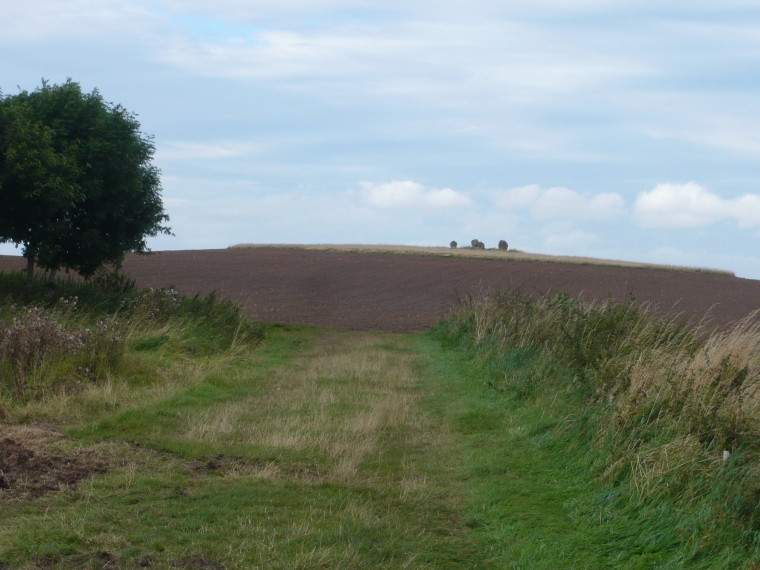
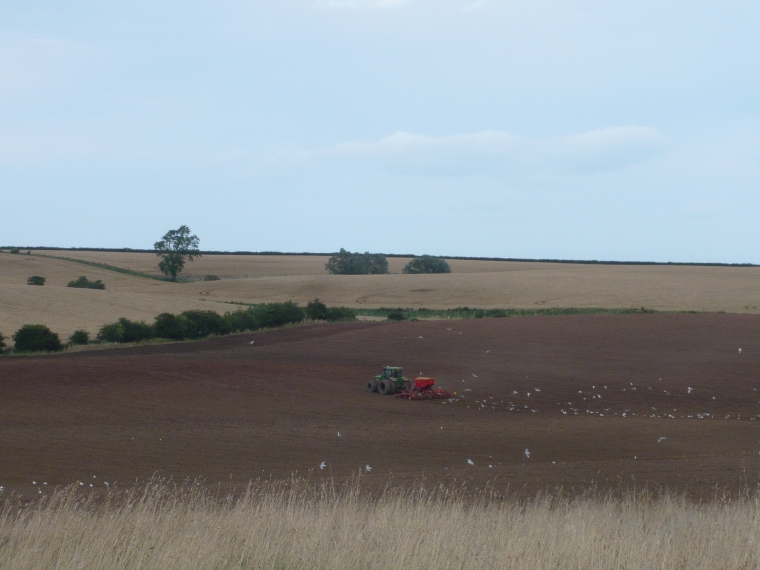
The photo above shows the view at the start of our walk with Great Hetha on the skyline. It’s 210 metres at the summit where there are the remains of an ancient hillfort. We parked in the car park just south of Hethpool and the walk began easily enough along the private road through the Valley. The photo below shows the Valley looking south:

After a short distance and turning right it’s a steep uphill climb described in Walks in the Cheviot Hills by David Haffey as a ‘strenuous climb‘! I was soon struggling for breath. We stopped halfway up to look at the view northwards to Scotland (and to get our breath back!).

Looking up at that point we could see a small cairn on the summit, still a steep climb ahead.

It was worth the climb to reach the hillfort. This is an Iron Age hillfort dating from about 500BC. The remains of the stone ramparts are still there and it was easy to imagine what it must have been like in such an isolated place, being able to see for miles around, aware of any approach to the hill. According to the Walks guidebook such hillforts would have contained several timber-built round-houses within the stone ramparts, probably being occupied for several centuries.

From there we left the route in the guidebook and walked down the other side of the hill to the valley below and crossed the Elsdon Burn. The sky was most dramatic:

It was getting towards the end of the afternoon and as we headed back to the car, the sheep were being rounded up in the field, below a wooded dome-shaped hill known locally as the Collingwood Oaks (after Admiral Lord Collingwood – there is a hotel in Cornhill called the Collingwood Arms, more about that another time maybe). I wasn’t quick enough to take a photo of the running sheep (they were galloping!) but I managed to snap the farmer and his three sheepdogs on their way back, with the Collingwood Oaks in the background.

There are more photos of our walk on Flickr.

Saturday Snapshot is hosted by Alyce, At Home With Books.

Saturday Snapshot

Earlier this year we visited Conundrum Farm:

We walked the farm trail where you can feed the animals. Our granddaughter liked the pygmy goats:

I wasn’t too keen on this somewhat larger goat that apparently often jumps over the fence and wanders around the farm:

There’s also a Battle Trail, which we didn’t do, across the battlefield of Halidon Hill, where the English recaptured Berwick-upon-Tweed from the Scots in 1333. We’re saving that for another visit.

See more Saturday Snapshots on Alyce’s blog At Home With Books.

Saturday Snapshot

 I took this photo a few weeks ago through the window of The Maltings Kitchen, in Berwick-upon-Tweed. It shows the River Tweed on its way down into the North Sea, a seagull sitting on top of one of the chimneys below the restaurant, and a crow-stepped gable end of one of the buildings. And on the skyline you can just see the Royal Border Bridge carrying the East Coast Main Line Railway over the Tweed, built by Robert Stephenson and opened by Queen Victoria in 1850.

Saturday Snapshot is hosted by Alyce at At Home with Books.

Saturday Snapshot

I posted photos of a ruined castle last Wednesday. Today I’m featuring a much larger castle – Alnwick Castle, which is the second largest inhabited castle in England.  The Duke of Northumberland and his family live here; the family have lived at Alnwick for 700 years. The castle was used to film parts of some of the Harry Potter films – the castle was Hogwarts in the first two films and Harry’s broomstick flying lessons were filmed in the Outer Bailey. Other films made there include Elizabeth and Robin Hood Prince of Thieves.

We went there the week before last with our grandson, a lover of Harry Potter. He liked the historical setting, the battlements and the canons,  but most of all I think he liked the Knights’ Quest and the Harry Potter magic show, with Harry and Professor Dumbledore:

We’ll have to go back for another visit as there is so much to see and we only had time for a quick walk round the State Rooms, which are very grand, although I was amused to see a Table Football in the Library (I think that is where it was), definite proof that Alnwick Castle is also a family home.

See more Saturday Snapshots at Alyce’s blog At Home with Books.

Castles

As a lover of history (as well as books) I love castles, particularly ruined castles – or as my grandson calls them smashed castles. Here are some photos of one near us.

This is Norham Castle, high above the south bank of the River Tweed, parts of it date back to the 12th century.

It was repeatedly attacked and besieged and was largely destroyed by James IV of Scotland in 1513 before the Battle of Flodden Field.

The photo below shows the remains of the huge Great Tower, where the Bishop of Durham  and his guests would stay when they visited the Castle.

J M W Turner painted several views of the ruined castle – they are in the Tate Collection. And I like this 1836 engraving of Moon Rise at Norham Castle by William Miller:

An ABC Wednesday post for the letter C.

Saturday Snapshots – Castles

Bamburgh Castle seen from Lindisfarne

This is Bamburgh Castle, off the coast of Northumberland south of the Holy Island of Lindisfarne and on Monday when we went to  the Island, it was clearly visible on the horizon. The sea was shimmering in the sunshine.

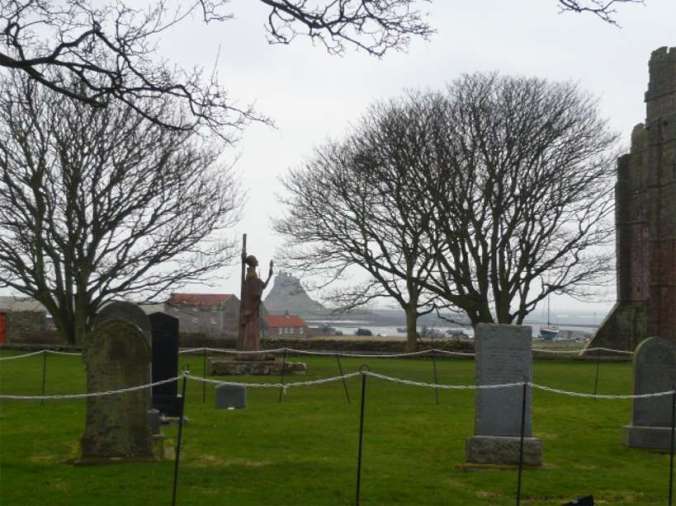
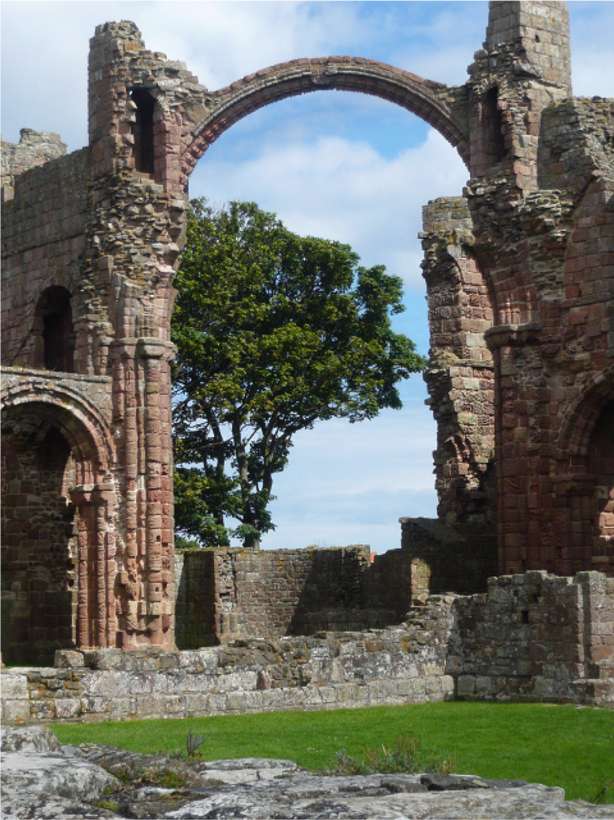
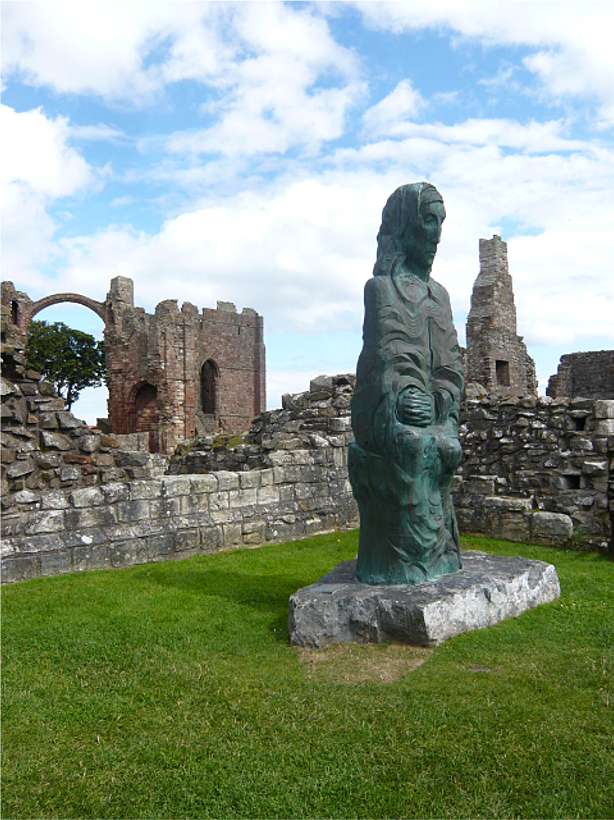
I posted a photo of Lindisfarne Castle when we visited the island in March. Early on Monday morning it was raining but it soon stopped and the sun came out, even though it remained extremely windy.

The Castle was originally an Elizabethan fort protecting the harbour. It was built between 1570 and 1572 and was garrisoned for over 300 years – guns and soldiers were removed in 1893. Now it is owned by the National Trust.

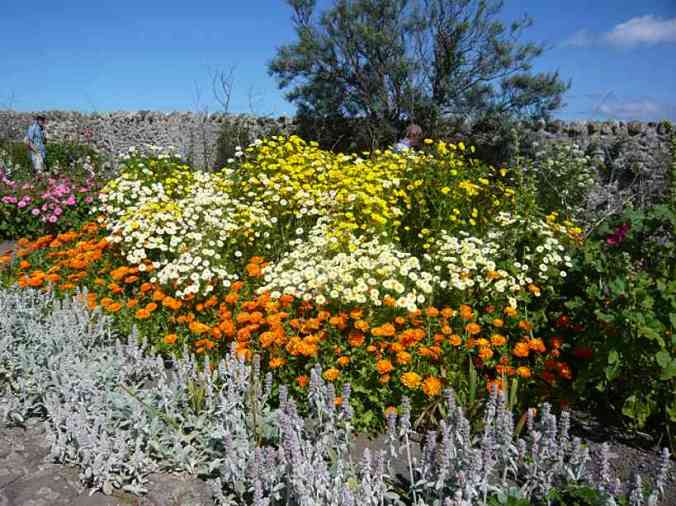
The photo below is of Lindisfarne Castle taken from the walled garden designed by Gertrude Jekyll north of the Castle. The site of the garden was where the soldiers of the fort had formerly grown vegetables.

Lindisfarne Castle

Inside the Castle it’s an Edwardian house, designed by the architect Edwin Lutyens for his friend Edward Hudson, who was the founder of Country Life magazine. By 1902 the castle was derelict and Lutyens turned it into a holiday home for Hudson. It’s both homely and dramatic. There are columns and rounded arches; the rooms are all small  - you can imagine yourself living there. The dining room in the old Tudor fortress has a vaulted ceiling with a wide arched chimney-piece. It had once been a bakery and there is an old bread oven next to the fireplace.

Lindisfarne Castle Dining Room

These days you can get married in the Ship Room, so called because of the wooden model ship that hangs from the ceiling, flanked by two Dutch 17th century chandeliers:

Lindisfarne Castle Ship Room

For more Saturday Snapshots see Alyce’s blog At Home with Books.

L is for L S Lowry

L S Lowry was an English painter well known for his urban paintings of industrial towns like Salford in Lancashire, scenes peopled by his ‘matchstalk men and his matchstalk cats and dogs‘ (I always thought it was ‘Matchstick’ not ‘Matchstalk’, until I checked the song lyrics today!)

What is less well known (at least to me) was that he also painted many scenes of Berwick-upon-Tweed a seaside town he regularly visited from the 1930s until a couple of years before his death in 1976.

There is a Lowry Trail around the town and here are some photos of one of the locations:

This is ‘On the Sands‘, oil on canvas 1959 (click on the photo to enlarge), showing his matchstick figures. The shelter became dilapidated and was restored in 2001. This is how it looks today:

There is actually a little beach behind this scene:

This is my contribution to ABC Wednesday L is for …