Wild Swans by Jung Chang

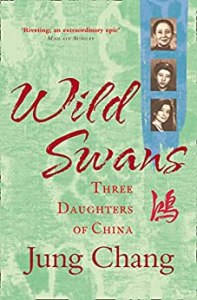
It’s taken me a couple of months to read Wild Swans: Three Daughters of China (first published in 1991), Jung Chang’s book about her grandmother, her mother and herself, telling of their lives in China up to and during the years of the violent Cultural Revolution. Her family suffered atrociously, her father and grandmother both dying painful deaths and both her mother and father were imprisoned and tortured.

Needless to say that this is a harrowing book to read, but it’s also an eye-opener (for me at any rate) about what happened in China under Mao.

Jung Chang was born in Yibin, Sichuan Province, China, in 1952. She was briefly a Red Guard at the age of fourteen, and then a peasant, a ‘barefoot doctor’, a steelworker and an electrician. She came to Britain in 1978, and in 1982 became the first person from the People’s Republic of China to receive a doctorate from a British university. ‘Wild Swans’  won the 1992 NCR Book Award and the 1993 British Book of the Year. She lives in London.
In Wild Swans she casts light on why and how Mao was able to exercise such paralysing control over the Chinese people. His magnetism and power was so strong and coupled with his immense skill at manipulation and his ability to inspire fear, it proved enough to subdue the spirit of most of the population; not to mention the absolute cruelty, torture and hardships they had to endure.

I wondered how she knew so much about what happened to her mother and grandmother (I don’t know nearly as much about mine) but in the Introduction she explains that when her mother came to visit her in London they talked every day for months. She talked about their eventful lives – her grandmother had been a concubine of a warlord general and her mother had joined the Communist underground at the age of 15. She also recorded sixty hours of her memories.

I wrote a bit about the book in a Book Beginnings post at the end of last November, when I’d just started to read it. It’s a personal story, reflecting the twentieth century history of China. A remarkable book, full of courage and spirit.

  • Paperback: 720 pages
  • Publisher: HarperPress; New edition edition (1 Mar 2012)
  • Language: English
  • ISBN-10: 0007463405
  • ISBN-13: 978-0007463404
  • Source: borrowed from a friend

Book Beginnings: Wild Swans by Jung Chang

I’m currently reading Wild Swans by Jung Chang.

It begins:

At the age of fifteen my grandmother became the concubine of a warlord general, the police chief of a tenuous national government of China. The year was 1924 and China was in chaos. Much of it, including Manchuria, where my grandmother lived, was ruled by warlords. the liaison was arranged by her father, a police official in the provincial town of Xixian in southwest Manchuria, about a hundred miles north of the Great Wall and 250 miles northeast of Peking.

Wild Swans is a family memoir – the story of three generations of woman in Jung Chang’s family – her grandmother, mother and herself. This is the 2003 edition with an introduction by Jung Chang explaining how she came to write the book. She had always dreamed of being a writer, but growing up in Mao’s China it seemed out of the question, with most writers suffering in endless police persecutions. It was only after she had been allowed to come to Britain in 1978 to study that she had the freedom to write and to write what she wanted.

So far, I’m finding it fascinating, reading about her grandmother, who was one of the last generation of Chinese woman to suffer the practice of binding feet. I knew of this practice, but hadn’t realised just how much the little girls suffered and continued to suffer throughout their lives.

As this book is so long (over 600 pages in a small font) it’s going to take me quite a while to read it. I’l probably write a few posts on my progress.

First Chapter, First Paragraph is hosted by Diane at Bibliophile by the Sea.

From the Archives: Biographies

This is a second post in which I’m following Simon’s example at Stuck in a Book of posts in which he revisits his old reviews. I’ve been looking back into my archives at biographies – triggered by Katrina’s post on Daphne du Maurier’s Rebecca Notebook, which I’ve also read and written about in 2010.

So here’s a list of some of my posts on biographies of authors – with links to the posts, a short summary and a quotation from my review.

First of all two from 2007:

  • Daphne by Margaret Forster – a biography of Daphne Du Maurier, the author of Rebecca etc

From my post: There is too much I could say about ‘Daphne’, not least that it is a candid account of her relationships, eg her troubled married life; wartime love affair; and friendships with Gertrude Lawrence and Ellen Doubleday, as well as an excellent source of information on Du Maurier’s method of writing and views on life.

  • Lewis Carroll by Morton N Cohen – a biography of Charles Dodgson (Lewis Carroll) a long post  which has a somewhat controversial interpretation of some aspects of Dodgson’s life.

From my post: his account of Charles Dodgson’s life is basically chronological, but because he also looks at different aspects of Charles’s life it is a bit repetitive. As biographies go this is not one of the most straightforward or readable. It’s extremely detailed and at nearly 600 pages it is not a quick read.

One from 2008:

  • Dear Dodie by Valerie Grove – biography of Dodie Smith, the author of I Capture the Castle etc.

From my post: It is very readable and gives a very full picture of Dodie’s life, and it has an excellent index (always a plus for me). 

And two from 2009:

  • Wild Mary by Patrick Marnham – biography of Mary Wesley, the author of Camomile Lawn and other books.

From my post:  … I certainly wouldn’t like to have met Mary. She seems to have been a difficult and determined woman who aroused strong passions in those who knew and loved her.

From my post: My outstanding impression of the book is how amazingly detailed it is given the fact that few records of her life have survived.

A Card From Angela Carter by Susannah Clapp: Book Notes

I liked the look of A Card from Angela Carter when I saw it in the library. It’s a small book that slots easily into a pocket or handbag and is very short – just 103 pages. I thought it would be a nice change after some of the very long books I’ve been reading recently.

I also liked the concept – a study of Angela Carter using the postcards she had sent to Susannah Clapp, who is the literary executor of Angela Carter as well as being a publisher’s reader, editor and critic. She and Angela had been friends for a number of years.

Now, Angela Carter is one of those writers whose books I’ve been meaning to read and have never got round to them, so I thought this book, which forms a sort of biography would give me at least an elementary picture  of her life and work. And that’s just what it did. Now I really do want to read some of her books – Angela Carter’s Book of Fairy Tales and Nights at the Circus, for example. I really find it hard to realise that it is twenty years ago now since she died at the age of 51 from lung cancer.  The fact that she had never made the shortlists of the Booker Prize led to the foundation of the Orange Prize, but this book, slight as it is, is the only biographical work to have been published.

Susannah Clapp uses the postcards Angela had sent to her ‘form a paper trail through her life.’ Sent from various places around the world some have a full message, some only a few words, which Susannah uses to paint a picture of what Angela was like, a ‘great curser’, capable of the sharpest of remarks, clever, unpredictable, quirky, and funny. She laughed and talked a lot. Using the postcards as a trigger, the book is mainly Susannah’s recollections of Angela, full of stories of her family life, her political views and what the critics made of her work. There’s also a considerable amount, considering the length of the book, about her physical appearance.

As for the postcards, I was disappointed at the black and white reproductions. I was also disappointed that as she is not a cat lover, Angela had not sent her any cards featuring felines, although she did send them to her friend and publisher Carmen Callil. Angela herself loved cats and her first book written at the age of six was called ‘Tom Cat Goes to Market’, which her mother eventually threw away!

Susannah Clapp, whilst allowing that Angela’s fiction and prose did not go unacknowledged while she was alive, considers that her work did not receive the acclamation it deserved because:

She was ten years too old and entirely too female to be mentioned routinely alongside Martin Amis,  Julian Barnes and Ian McEwan as being a young pillar of British fiction. She was twenty years too young to belong to what she considered the ‘alternate pantheon’ of Iris Murdoch, Doris Lessing and Muriel Spark in the forties, when ‘in a curious way, women formed the ascendancy.’ (page 3)

This is an entertaining and vivid account in miniature which left me wanting to know more and to read Angela Carter’s books for myself.

Daphne du Maurier: Fact and Fiction

Recently I’ve had a bit of a run on books by and about Daphne du Maurier. First of all I read The Parasites, which reminded me that I’d had Justine Picardie’s novel, Daphne sitting on my bookshelves unread, so I immediately got it down. Then I just had to read My Cousin Rachel, a book I’ve had for years and never got round to reading before now. After that I read Daphne du Maurier: a Daughter’s Memoir by Flavia Leng, just because it was one of the books Justine Picardie consulted in writing her novel. I’ve previously read Margaret Forster’s biography Daphne du Maurier and Daphne du Maurier’s The ‘Rebecca’ Notebook and Other Memories, which is mainly autobiographical.

Daphne by Justine Picardie (2008) – synopsis (from the back cover):

It is 1957. As Daphne du Maurier wanders alone through her remote mansion on the Cornish coast, she is haunted by thoughts of her failing marriage and the legendary heroine of her most famous novel, Rebecca, who now seems close at hand. Seeking distraction, she becomes fascinated by Branwell, the reprobate brother of the Bronte sisters, and begins a correspondence with the enigmatic scholar Alex Symington in which truth and fiction combine. Meanwhile, in present day London, a lonely young woman struggles with her thesis on du Maurier and the Brontes and finds herself retreating from her distant husband into a fifty-year-old literary mystery.

My view: 4/5

This book merges fact and fiction so well that it’s hard to differentiate between the two. I much preferred the story of Daphne herself and her search for information about Branwell. I had to go back to Forster’s biography of Daphne to compare the accounts of her life, which matched up pretty well. I was less keen on the modern day story of a young woman, the second wife of an older man. It had too many obvious parallels with Rebecca for my liking. And if you haven’t read Rebecca, this book gives away the plot. There are also references to My Cousin Rachel, which I glossed over in case there were any spoilers there too (I don’t think there were). All in all, a very satisfying mystery about Daphne and the missing Bronte documents.

My Cousin Rachel by Daphne du Maurier (1951) – synopsis (Amazon):

Orphaned at an early age, Philip Ashley is raised by his benevolent older cousin, Ambrose. Resolutely single, Ambrose delights in Philip as his heir, a man who will love his grand home as much as he does himself. But the cosy world the two construct is shattered when Ambrose sets off on a trip to Florence. There he falls in love and marries – and there he dies suddenly. In almost no time at all, the new widow – Philip’s cousin Rachel – turns up in England. Despite himself, Philip is drawn to this beautiful, sophisticated, mysterious woman like a moth to the flame. And yet …might she have had a hand in Ambrose’s death?

My view: 4/5

I thoroughly enjoyed this book, completely taken in by the characters and loving the setting in an old mansion in Cornwall. The story is narrated by Philip, so the other characters are seen through his eyes. The tension mounts as Philip becomes obsessed with Rachel and I was never quite sure what was real and what to believe. He is not a stable character and as Rachel’s own thoughts are not revealed it’s not clear if she can be believed either, whether she is sincere or evil and manipulative.

Daphne du Maurier: a Daughter’s Memoir (1994) – synopsis (from the back cover):

In this moving and revealing memoir, Flavia Leng paints a powerful portrait of her mother, Daphne du Maurier. She presents an account of an unusual and often lonely childhood spent in London and especially Cornwall, at her mother’s beloved home, Menabilly. Family friends included Nelson and Ellen Doubleday, Gertrude Lawrence and Noel Coward. However, at the centre of this story is Daphne du Maurier herself. The book reveals a writer with a deep attachment to Cornwall, where she put down her roots and found inspiration for her novels, and who spent much of her life as a recluse, withdrawn not only from the outside world but also from members of her own family. A picture emerges of a woman who lived in a world of her own creation that was beyond the comprehension of those around her.

My view: 3.5/5

In the epilogue Flavia Leng, Daphne du Maurier younger daughter, explained that she began to write this memoir of her childhood two years before her mother died in 1989 and it was never meant for publication – it was just for the family. And that to me epitomises this memoir – it’s an account of her childhood and of her family as seen through a child’s eyes. It seems a lonely childhood, despite being the middle child. As children Flavia and her older sister Tessa didn’t get on and both she and Tessa saw that their mother lavished more affection on her beloved son, Christopher who they called Kits. But a picture emerges of Daphne, who they called Bing, as a solitary person, closeted away with her typewriter or lost in her world of ‘never, never land’, peopled by the characters she invented, with little time for her children, who were looked after by Nanny and then ‘Tod’, their governess.

Like her mother Flavia has a great love of Cornwall which shines through the book – she was never happier than when alone in Menabilly and the surrounding woodlands. It’s a sad memoir ending with Flavia feeling she had no roots left after her parents died:

I have heard it said that a person only really grows up when both parents have gone; what I do know is that life will never be quite the same again. Cornwall no longer holds the enchantment it once did. Gone is the excitement of driving down those leafy, winding roads to the lovely old houses, my beloved Menabilly, and then later Kilmarth where Bing lived out her years.

Mini Reviews

I’ve been reading books recently and not writing anything about them. So, before they drop out of my mind completely here are a few notes:

Body Parts: Essays on Life Writing by Hermione Lee – this is a book about writing biography, which I’ve been reading on and off since I started it in 2007! I first wrote about my impressions in this post. It’s very good with an interesting selection, although some essays are a lot shorter than others. As with all books about writing it includes books and authors I haven’t read – and makes me want to read them – Eudora Welty for one. There are essays on T S Eliot, J M Coetzee, Jane Austen and Virginia Woolf, to name but a few.

My rating 4/5

A Wrinkle in Time by Madeleine L’Engle – I bought this book several years ago, so it’s one off my to-be-read list. A fantasy/science fiction magical classic and 1963 Newbery Medal winning book, which I thoroughly enjoyed. It’s the story of Meg and Charles, searching for their father, a scientist, lost through a ‘wrinkle in time’, with wonderful characters such as Mrs  Whatsit, Mrs. Who and Mrs. Which to help them.

My rating 4.5/5

Maigret in Court by Georges Simenon. Maigret is two years from retirement and is wondering about this with foreboding. He does seem rather tired as he investigates the murder of a woman and small child. The book begins in court as Maigret gives evidence against Gaston Meurat, but he is beginning to have doubts that Meurat is the murderer and carries on investigating to save Meurat from execution. A complicated story, packed into 126 pages, that at times had me completely puzzled.

My rating 3/5

I read two books on Kindle:

Breakfast at the Hotel Deja Vu by Paul Torday. I rather liked this little e-book about a politician, a former MP exposed in the expenses scandal and staying in a hotel abroad, whilst he recovers from an illness and writes his memoirs. All is not as it seems, however, as each day he discovers he hasn’t actually written anything.And just who are the woman and young boy he sees each morning?

My rating 4/5

Crime in the Community by Cecilia Peartree – a free e-book from Amazon. I was disappointed with this one – too wordy, and convoluted. It’s about a small group of people who are supposed to be organising events to improve their community, but who actually don’t do anything except go to meetings. I found this part quite true to life for some committees I’ve known. But then it got tedious and eventually too far-fetched with a retired spy, a missing person and a mental breakdown.

My rating 2/5

H is for Hardy

Thomas Hardy is one of my favourite authors. He was born in 1840 at Upper Bockhampton near Dorchester. What I love most about Hardy’s books are his lyrical descriptions of nature and the countryside and all his books show his great love and knowledge of the countryside in all its aspects. They also show his almost pagan sense of fate and the struggle between man and an omnipotent and indifferent fate. Hardy was a pessimist – man’s fate is inevitable, affected by chance and coincidence. It cannot be changed, only accepted with dignity. This is illustrated in his poem – Hap, written in 1866:

If but some vengeful god would call to me

From up the sky, and laugh: “Thou suffering thing,

Know that thy sorrow is my ecstasy,

That thy love’s loss is my hate’s profiting!”


Then would I bear, and clench myself, and die,      

Steeled by the sense of ire unmerited;

Half-eased, too, that a Powerfuller than I

Had willed and meted me the tears I shed.


But not so. How arrives it joy lies slain,

And why unblooms the best hope ever sown?

—Crass Casualty obstructs the sun and rain,

And dicing Time for gladness casts a moan….

These purblind Doomsters had as readily strown

Blisses about my pilgrimage as pain

The first book by Thomas Hardy that I read was The Trumpet Major – I think it was in the second year at secondary school. I remember very little about it, except that it was set during the Napoleonic Wars and I wasn’t too impressed. Then I read The Mayor of Casterbridge for A level GCE and thought it was wonderful. I still have my copy, with passages underlined and notes at the tops of pages – all in pencil. It’s full title is The Life and Death of the Mayor of Casterbridge: A Story of a Man of Character. It tells the tragic tale of Michael Henchard, a man of violent passions, proud, impulsive with a great need for love. It opens dramatically as he sells his wife and child to a sailor at a fair. By his own hard work over the years he eventually became the rich and respected Mayor of Casterbridge. But then the re-appearance of his wife and her daughter sets off a train of events finally bringing Henchard to ruin and degradation.

Because I enjoyed The Mayor over the years I’ve read more of Hardy’s books, including Tess of the D’Urbervilles and Jude the Obscure, both dramatic tragedies. In Jude Hardy attacked the Church and the marriage state, which received a mixed reception at the time – the Bishop of Wakefield burned his copy of the book and W H Smith withdrew it from their circulating library, but the public bought 20,000 copies, whether or not due to the scandal it aroused.  These books were considered masterpieces by some and scandalous by others.

Of the two I prefer Jude to Tess and having re-read them both more recently I still feel the same, but now I’m less impatient with the way Hardy presents Tess as a helpless victim than I had been before.  She is an innocent, raped by Angel Clare, the man she loves and Hardy highlights the hypocrisy of the times in condemning the ‘fallen woman’.

In Thomas Hardy, the Time-Torn Man Claire Tomalin writes not only about his life but also how he became a writer, poet and novelist. I began reading this book a few years ago and every now and then think I really must finish it. I stopped, as usual, overtaken by the desire to read other books- including more by Hardy himself.

The Thomas Hardy Society is an excellent source of information on the man and his works.

This is an ABC Wednesday post for the letter H.

One Book, Two Book, Three Book, Four… and Five…

Today I’m copying Simon and doing his little this-book-that-book-this-book-that-book sort of post.
  1. The book I’m currently reading:


    Cop Hater by Ed McBain – there are 13  87th Precint books – this is the first in his series. There’s a heat-wave and someone is killing cops. McBain was a Grand Master of the Mystery Writers of America and was one of three American writers to be awarded the CWA Diamond Dagger for lifetime achievement.

  2. The last book I finished:


    Gently Does It by Alan Hunter – The first of the Inspector Gently books. I read it on my Kindle and enjoyed it very much – post to follow later.
  3. The next book I want to read:


    The Weather in the Streets by Rosamond Lehmann – this is the next book for my face-to-face book group and I was talking to some of the other members yesterday who’ve already started it and they told me how good it is. It’s the story of Olivia and her love affair with a married man. I don’t often read romantic novels, so this will a change for me. I’m looking forward to reading it.
  4. The last book I bought:

    The last one I bought was The Weather in the Streets. The one before that was:

    Adam and Eve and Pinch Me by Ruth Rendell
    I bought this from the secondhand book box at Eyemouth Hospital. It’s hardback and looks practically brand new. I like buying books from the local hospitals as the money goes to a good cause. And I especially like buying them when they’re by authors I enjoy, such as Ruth Rendell.
  5. The last book I was given:


    Agatha Christie At Home by Hilary Macaskill. My husband gave me this for Christmas and I’m amazed at myself because I haven’t read it yet, although I’ve had a look at the photos. This is not just about Greenway, Agatha Christie’s Devon home but about her other houses and identifies the settings she used in her books.

Book Notes

I’ve recently finished reading two books:

It’s taken me several weeks to read Eden’s Outcasts and at one point I nearly abandoned it because I thought it was too much about Louisa May Alcott’s father. I’m glad I persevered because the second half of the book  concentrates much more on Louisa and I realised that the title does convey the subject matter very well as it reveals the relationship between them. Bronson Alcott was a complicated person who appeared to have mellowed as he grew older. Louisa, well known and loved for her children’s books never achieved her ambition to write serious books for mature readers, enduring debilitating illness in her later years.

I learnt a lot from this book about their lives and their relationships with other writers such as Emerson, Thoreau and Hawthorne. It’s a very detailed book and there is no way I can summarise their lives in a few words and a double biography is even more difficult to deal with. In the final  paragraph Matteson sums this up very well:

To the extent that a written page permits knowledge of a different time and departed souls, this book has tried to reveal them. However, as Bronson Alcott learned to his amusement, the life written is never the same as the life lived. Journals and letters tell much. Biographers can sift the sands as they think wisest. But the bonds that two persons share consist also of encouraging words, a reassuring hand on a tired shoulder, fleeting smiles, and soon-forgotten quarrels. These contracts, so indispensable to existence, leave no durable trace. As writers, as reformers, and as inspirations, Bronson and Louisa still exist for us. Yet this existence, on whatever terms we may experience it, is no more than a shadow when measured against the way they existed for each other. (page 428)

Turning to Climbing the Bookshelves by Shirley Williams,  I thought an autobiography would maybe include more personal recollections and descriptions of events. It starts off very well with her descriptions of her early childhood – her earliest memory from 1933 when she was three and fell on her head from a swing at the Chelsea Babies’ playground. I was very impressed by her memories of the time she spent in America as a young girl during the Second World War and her self-reliance and independence.

However, much of the book consists of her accounts of her political life, making it very much a political history of Britain, rather than a personal account of her life. There are some personal memories and I particularly liked her descriptions of her fellow politicians – Harold Wilson, Jim Callaghan, Roy Jenkins and so one – very little about Margaret Thatcher and a few pertinent comments about Tony Blair. Having said that she comes over as a very honest, genuine person who cares deeply about being a good politician. And maybe it is more personal than I originally thought because in the last chapter she writes these words:

Being an MP is like being a member of an extended family. You learn to love your family with all its knobbliness, perversity, courage and complexity. You learn respect and build up trust. …

To be a good politician in a democracy you have to care for people and be fascinated by what makes them tick. … The politician whose eyes shift constantly to his watch, or to the apparently most important person in the room, feeds the distrust felt by the electorate. It is a distrust born of being manipulated, conned, even decieved and it is fed by a relentlessly cynical national press. (page 389)

A side effect of reading this book is that I’m going to read her mother’s book, a best seller published in 1933 – Testament of Youth by Vera Brittain. Shirley describes it as

… an autobiography of her wartime experience as a nurse and her personal agony in losing all the young men she most loved … (page 13)

In the preface to Testimony of Youth she wrote:

Testimony of Youth is, I think, the only book about the First World War written by a woman, and indeed a woman whose childhood had been a very sheltered one. It is an autobiography and also an elegy for a generation. For many men and women, it described movingly how they themselves felt.

This looks like a much more personal autobiography.

The Sunday Salon

Today I’ve been reading more from Eden’s Outcasts: the story of Louisa May Alcott and Her Father. At long last, as I have been reading this book for ages, I have arrived at the time of Louisa’s life where she has written and published Little Women. Up to this point (about 60% of the book) most of it has been about Bronson Alcott, her father and it is Louisa who I find most interesting.

Louisa wrote in vortices – completely engrossed in her writing, with barely time for anything else, so intense was her concentration. Mostly she wrote in her bedroom at a desk Bronson had built for her, but sometimes she sat on the parlour sofa. Her family knew that if the bolster pillow next to her stood on its end they could speak to her, but if the pillow lay on its side they couldn’t disturb her. In two and a half months she had completed writing 402 manuscript pages and at the end of it she had briefly broken down.

Little Women was an instant success, the first printing of 2,000 copies sold out within days of the book’s release and another 4,500 copies were in print by the end of the year (1868). Three months later she had written the second part of Little Women – the book I know as Good Wives. She had

… plunged back into a creative cortex on November 1, vowing to write a chapter a day. She worked ‘like a steam engine’, taking a daily run as her only recreation and barely stopping to eat or sleep.  Falling behind the ambitious schedule she had set for herself, she spent her birthday alone’writing hard.’ (page 345)

She put her heart and soul into her writing.

Both Louisa and her father were complex characters and Matteson’s biography is detailed and in depth. It’s not a quick read, but then biographies never are in my experience.