Stacking the Shelves is hosted by Marlene at Reading Realityand the details are on her blog, as well as a huge amount of book reviews. Why not visit her blog if you haven’t already found it? The gorgeous graphic is also used courtesy of the site.
The idea is to share the books you are adding to your shelves, may they be physical or virtual. This means you can include books you buy in physical stores or online, books you borrow from friends or the library, review books, gifts and of course e-books!
I’ve been away on holiday near Gatehouse of Fleet in Dumfries and Galloway, Scotland. We had a brilliant time in a lodge overlooking Fleet Bay, part of the Solway Firth.
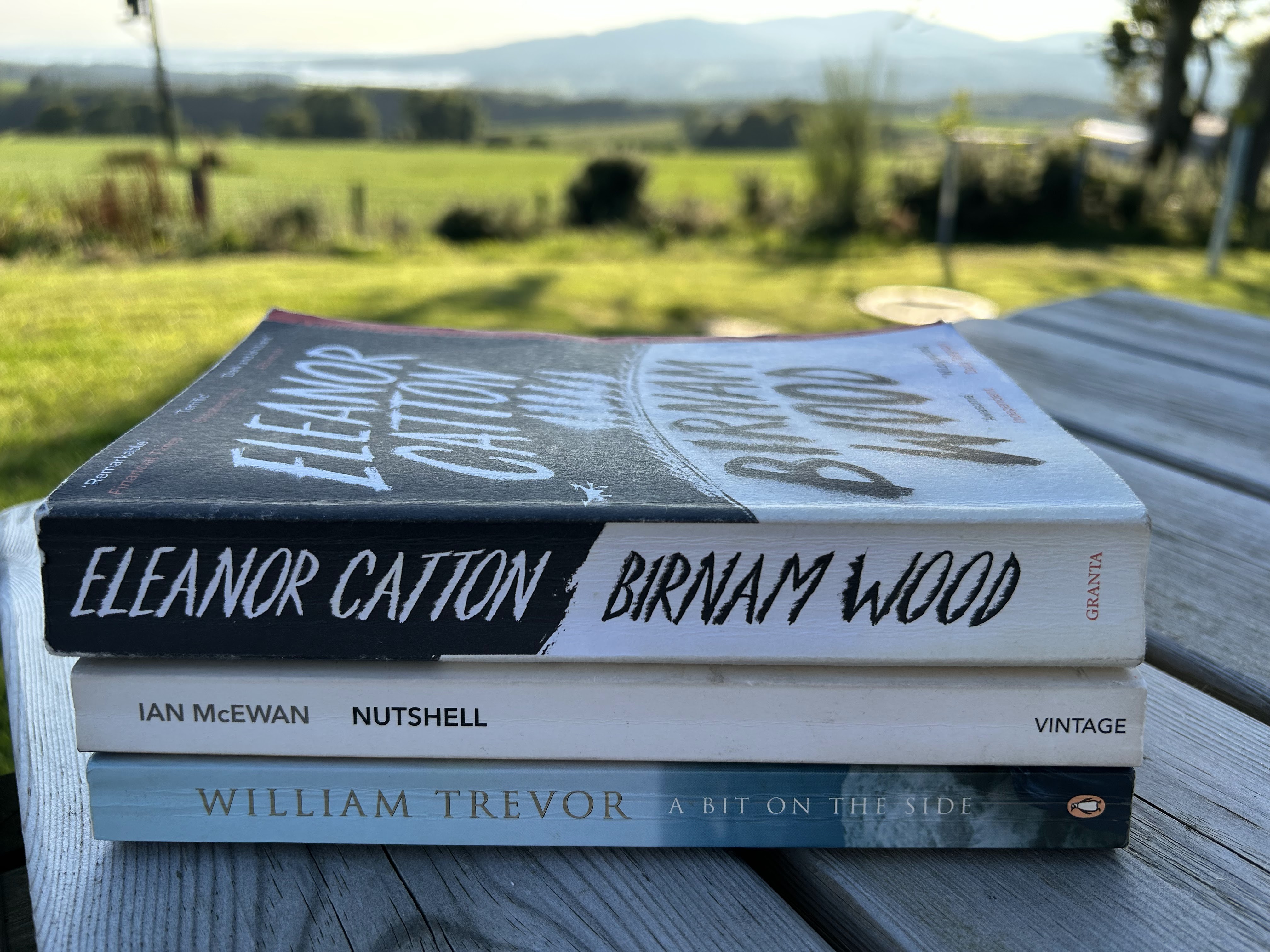
I bought these three paperbacks from a charity shop in Gatehouse of Fleet:
Birnam Wood by Eleanor Catton – Like her previous novel The Luminaries, which I loved, this book is set in a fictionalised New Zealand, primarily in and around a national park in the South Canterbury region. The title is taken from a line in Macbeth. It follows members of a guerilla gardening collective, Birnam Wood as, with the help of a charismatic tech billionaire, they undertake a new project on abandoned farmland.
Nutshell by Ian McEwan, a version of Hamlet. Trudy has betrayed her husband, John. She’s still in the marital home – a dilapidated, priceless London townhouse – but not with John. Instead, she’s with his brother, the profoundly banal Claude, and the two of them have a plan. But there is a witness to their plot: the inquisitive, nine-month-old resident of Trudy’s womb. I’ve enjoyed some of McEwan’s books, but this one looks rather different and, having read a few pages, I’m not sure about it.
A Bit on the Side by William Trevor, a collection of twelve short stories. I don’t think I’ve read any of Trevor’s books, but I thought this one looks interesting, with stories about adultery, secret passions and domestic infidelities. ‘A treat … each meditate[s] on the subject of love – adulterous, unspoken, clandestine, sometimes cruel. Whether set in rural Ireland or London, their pages whisper of relished secrets and dreams foolishly clung to’ Mail on Sunday.
These are e-books I’ve either bought for 99p or acquired for free this month:
The Testaments – Margaret Atwood’s sequel picks up the story more than fifteen years after Offred stepped into the unknown, with the explosive testaments of three female narrators from Gilead. The Republic of Gilead is beginning to rot from within. At this crucial moment, two girls with radically different experiences of the regime come face to face with the legendary, ruthless Aunt Lydia. But how far will each go for what she believes?
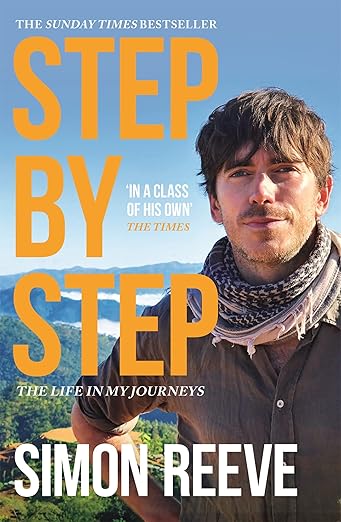
Step by Step: The Life In My Journeys by Simon Reeve. I love his TV travel programmes, so this was a 99p must for me. It’s his autobiography describing how he has journeyed across epic landscapes, dodged bullets on frontlines, walked through minefields and been detained for spying by the KGB. His travels have taken him across jungles, deserts, mountains and oceans, and to some of the most beautiful, dangerous and remote regions of the world. He gives the full story behind some of his favourite expeditions, and traces his own inspiring personal journey back to leaving school without qualifications, teetering on a bridge, and then overcoming his challenges by climbing to a ‘Lost Valley’ and changing his life … step by step.
The First Witch of Boston by Andrea Catalano, her debut novel. This was free from Amazon Prime this month. It is based on the true story of Margaret Jones, the first woman to be found guilty of witchcraft in Massachusetts Bay Colony, 1646. When Thomas and Margaret Jones arrive from England to build a life in the New World Margaret’s skill with healing herbs rouses suspicion of black magic. Personal tragedies, religious hysteria, and wariness of the unknown turn most against her, and even the devotion Margaret and her husband share is at risk.
I enjoy historical fiction and Mist Over Pendle by Robert Neill, (American title, The Elegant Witch) is one of my favourite novels. It tells the tale of witchcraft set in a wild inaccessible corner of Lancashire leading up to the trials of the famous Pendle witches in 1612. So, I thought it would be interesting to compare the two books.
Every Friday Book Beginnings on Friday is hosted by Gillion at Rose City Readerwhere you can share the first sentence (or so) of the book you are reading. You can also share from a book you want to highlight just because it caught your fancy.
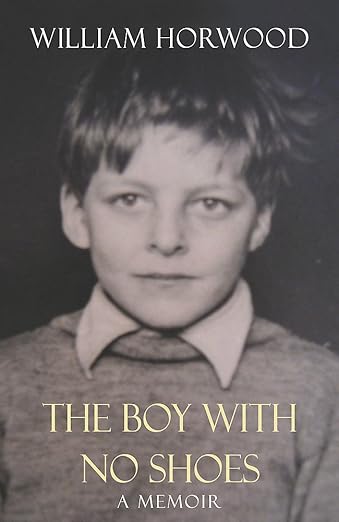
I’m featuring The Boy With No Shoes by William Horwood, a memoir I started to read today. William Horwood is an English novelist. His first novel, Duncton Wood, an allegorical tale about a community of moles, was published in 1980. It was followed by two sequels, forming The Duncton Chronicles, and also a second trilogy, The Book of Silence. William Horwood has also written two stand-alone novels intertwining the lives of humans and of eagles, The Stonor Eagles and Callanish, and The Wolves of Time duology. Skallagrigg, his 1987 novel about disability, love, and trust, was made into a BBC film in 1994. In addition, he has written a number of sequels to The Wind in the Willowsby Kenneth Grahame.
In 2007, he collaborated with historian Helen Rappaport to produce Dark Hearts of Chicago, a historical mystery and thriller set in nineteenth-century Chicago. It was republished in 2008 as City of Dark Heartswith some significant revisions and cuts under the pen name James Conan.
The book begins with the Author’s Note:
When I was thirty-four and had been iller than I knew for two long years, my recovery began in the strangest and most magical of ways. I woke one day from dreaming and saw myself when very young, as clearly as in a black -and-white Kodak photograph. I saw how desperately the little boy I once was had needed someone to talk to in a world where no one wanted to listen.
From the Prologue:
My name is Jimmy and there was a man in my time long ago, before the Boy and the Girl, before my Darktime, before Granny came to help me; and the man held my hand and took me out of our cold house into the sun and then along a street to a great big place with a sign outside
From Chapter 1 Running:
The park keeper in his uniform and hat shouted at me and grabbed one of my ears and pulled me towards him.
‘KEEP OFF THE GRASS!’ he yelled, so close it made my eardrums ache.
Also every Friday there is The Friday 56, hosted by Freda at Freda’s Voice, but she is taking a break and Anne at My Head is Full of Books has taken on hosting duties in her absence. You grab a book and turn to page 56 (or 56% of an eBook), find one or more interesting sentences (no spoilers), and post them.
On page 56 the characters are talking about the day that Edmund Hillary from New Zealand and Sherpa Tensing from Tibet had climbed the highest mountain in the world. No one in the whole history of the world had stood on top of it before.
Uncle Max said, ‘This is a great day for England and the monarchy.’
Granny said, ‘It seems to me that it is a great day for New Zealand and for Tibet, and a bad day for Mount Everest. It is nothing to do with England at all, let alone the Queen.
Description from Goodreads:
Five-year-old Jimmy Rova is the unwanted child of a mother who rejects him, and whose other children bully him. The one thing he can call his own is a pair of shoes, a present from the only person he feels has ever loved him. When they are cruelly taken away, Jimmy spirals down into a state of loneliness and terrible loss from which there seems no recovery. This triumphant story of a boy’s struggle with early trauma and his remarkable journey into adulthood is based on William Horwood’s own remarkable childhood in south-east England after the Second World War. Using all the skills that went into the creation of his modern classics, Horwood has written an inspiring story of a journey from a past too painful to imagine to the future every child deserves.
Spell the Month in Books is a linkup hosted by Jana on Reviews From the Stackson the first Saturday of each month. The goal is to spell the current month with the first letter of book titles, excluding articles such as ‘the’ and ‘a’ as needed. That’s all there is to it! Some months there are optional theme challenges, such as “books with an orange cover” or books of a particular genre, but for the most part, any book you want to use is fair game!
The optional theme this month is Stars/Sky. All these book covers include the sky in different weather conditions, and one also has stars.
Forensics expert Ruth Galloway is called in to investigate when builders, demolishing a large old house in Norwich, uncover the skeleton of a child – minus the skull – beneath a doorway. Is it some ritual sacrifice of just plain straightforward murder?
I like the mix of archaeology, mystery and crime fiction in Elly Griffiths’s books. This one has a double dose, with mythology and Catholicism running through the narrative as well as the police procedures. Ruth is an interesting character, not your usual detective, she’s overweight, self-reliant but also feisty and tough. She has to be with everything that’s thrown at her and as her investigations lead her into great danger.
U is for Under the Tuscan Sun by Frances Mayes
In this book the author describes how she bought and renovated an abandoned villa. It’s full of the pleasures of living in Tuscany – the sun, the food, the wine and the local people. It makes me want to do the same! It’s nothing like the film they made of it – the book is much better. Bella Tuscany is the follow up book with more details about the restoration of the villa and its garden, plus recipes.
I used this book in June’s Spell the Month in Books, but I’m using it again because it’s perfect for the theme of Sky/Stars this month!
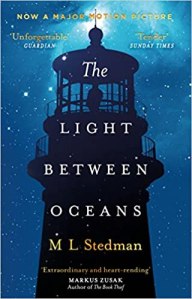
This is the story of Tom, a lighthouse keeper on an isolated island, Janus Rock, and his wife Isabel. Janus Rock )a fictional island) is nearly half a day’s journey from the coast of Australia, where the Indian Ocean washes into the Great Southern Ocean. When a boat washes up on the shore of the island it holds a dead man – and a crying baby. Tom and his wife have a devastating decision to make.
I’ve watched the TV series and loved it. This book is one of four books by Peter Wright, telling his life story, charting his working relationship with the famous ‘James Herriot’, from work experience with him as a lad, to taking over his practice in the beautiful Yorkshire Dales.
Packed full of laugh-out loud moments, heartbreaking stories and transporting tales of his love for the animals and people of this breathtaking part of the country. Covering his bucolic childhood growing up on a farm right through to the heady days of his successful Channel 5 TV series, Peter’s warm nature and professional attitude shine through every page.
The next link up will be on August 3, 2024 when the optional theme will be Water.
St Martin’s Press| 23 April 2024 | 228 pages|e-book |Review copy| 5*
Synopsis:
Taking a curtain call with a live snake in her wig..
Cavorting naked through the Warwickshire countryside painted green...
Acting opposite a child with a pumpkin on his head…
These are just a few of the things Dame Judi Dench has done in the name of Shakespeare
For the very first time, Judi opens up about every Shakespearean role she has played throughout her seven-decade career, from Lady Macbeth and Titania to Ophelia and Cleopatra. In a series of intimate conversations with actor & director Brendan O’Hea, she guides us through Shakespeare’s plays with incisive clarity, revealing the secrets of her rehearsal process and inviting us to share in her triumphs, disasters, and backstage shenanigans.
Interspersed with vignettes on audiences, critics, company spirit and rehearsal room etiquette, she serves up priceless revelations on everything from the craft of speaking in verse to her personal interpretations of some of Shakespeare’s most famous scenes, all brightened by her mischievous sense of humour, striking level of honesty and a peppering of hilarious anecdotes, many of which have remained under lock and key until now. Instructive and witty, provocative and inspiring, this is ultimately Judi’s love letter to Shakespeare, or rather, The Man Who Pays The Rent.
My thoughts
I was enthralled by Shakespeare: the Man Who Pays the Rent. Reading it is like being in the room with Dame Judi Dench and Brendan O’Hea as they talked about Judi’s career, her love for Shakespeare, and the numerous roles she has played over the years. Shakespeare to Judi Dench is a passionate affair, she talks about it with love.
My introduction to Shakespeare was at secondary school, when each year we studied one of his plays. Then some years ago I took an Open University course on Shakespeare, so I’ve read and seen performances of many of the plays in which she has acted. Unfortunately she wasn’t acting in any of the plays I’ve seen on stage. I enjoyed Shakespeare at school but it was only when I took the Open University course and saw the plays live on the stage that I really began to love them. And when I read Shakespeare: the Man Who Pays the Rent it brought it all back to me.
This book is a wonderful run through the plays told from Judi’s perspective and, of course, her life, giving her insight not only into the characters but also into the world of the theatre. She talks about the rehearsals, the costumes, the sets, other actors, about critics, Shakespeare’s language – similes and metaphors, the use of rhyme, prose and verse, soliloquies, asides and how to adjust your breathing – and so on. Whatever she is talking about is all so clear and relevant, full of wit and humour and understanding. It brought back such wonderful memories of the plays I’ve studied and seen performed. And as for the plays I don’t know this book makes me want to see those as well.
It is a book I shall return to whenever I need a pick me up – I loved it, it gave me so much joy. There is so much more in this book than I’ve included here – I have only covered the surface in this post. If you like Judi Dench and Shakespeare you really should read Shakespeare: the Man Who Pays the Rent by Judi Dench with Brendan O’Hea. And it includes Illustrations by Judi Dench too!
With many thanks to the authors, the publishers and NetGalley for an Uncorrected Galley.
Several years ago I used to take part in the Stacking the Shelves meme. This meme is now hosted by Marlene at Reading Reality and the details are on her blog, as well as a huge amount of book reviews. Why not visit her blog if you haven’t already found it? The gorgeous graphic is also used courtesy of the site.
It’s all about sharing the books you are adding to your shelves, may they be physical or virtual. This means you can include books you buy in physical stores or online, books you borrow from friends or the library, review books, gifts and of course e-books!
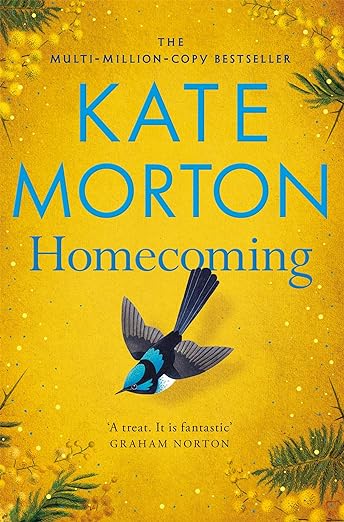
A breathtaking mystery of love, lies and a cold case come back to life, Homecoming is an immersive, twisting epic from the bestselling Kate Morton, told with her trademark intricacy and beauty.
Adelaide Hills, 1959. At the end of a scorching hot day, in the grounds of a grand country house, a local man makes a terrible discovery. Police are called, and the small town of Tambilla becomes embroiled in one of the most mystifying murder investigations in the history of Australia.
London, 2018. Jess is a journalist in search of a story. Having lived and worked in London for nearly two decades, a phone call summons her back to Sydney, where her beloved grandmother, Nora, has suffered a fall and is seriously ill in hospital.
Seeking comfort in her past, Jess discovers a true crime book at Nora’s house chronicling a long-buried police case: the Turner Family Tragedy of 1959. And within its pages she finds a shocking personal connection to this notorious event – a crime that has never truly been solved.
After the mysterious disappearance of her fiancé, Alma Hughes moves to a remote island in the North Atlantic, where she hopes to weather her grief and nurture her ailing dog. But the strange town of Violette has mysteries as well.
Townsfolk say that the radio tower overlooking their town broadcasts messages through their home appliances, their dreams, even the sea itself. When lightning strikes the tower, illuminating the sky in a brilliant flash, Alma finds herself caught in the unexplainable aftermath of one of Violette’s deadliest storms.
As the sea consumes the island, threatening its very existence, the deaths and lost memories of the recently departed also devastate the community. Alma, with a unique link to the lost, may be the only one who can help them move on. But to do so, she must confront a tragic loss of her own.
On this doomed island haunted by echoes of the departed, Alma searches for meaning in her future—and dares to discover the power of hope among the living.
As a Bolton teenager with a paper round, Clive Myrie read all the newspapers he delivered from cover to cover and dreamed of becoming a journalist. In this deeply personal memoir, he tells how his family history has influenced his view of the world, introducing us to his Windrush generation parents, a great grandfather who helped build the Panama Canal, and a great uncle who fought in the First World War, later to become a prominent police detective in Jamaica.
~~~
An Instance of the Fingerpost: Explore the murky world of 17th-century Oxford by Iain Pears – Oxford in the 1660s. Sarah Blundy stands accused of the murder of Robert Grove, a fellow of New College. Four witnesses describe the events surrounding his death: Marco da Cola, a Venetian Catholic intent on claiming credit for the invention of blood transfusion; Jack Prescott, the son of a supposed traitor to the Royalist cause, determined to vindicate his father; John Wallis, chief cryptographer to both Cromwell and Charles II, a mathematician, theologian and master spy; and Anthony Wood, the famous Oxford antiquary. Each one tells their version of what happened but only one reveals the extraordinary truth. Brilliantly written and utterly convincing.
~~~
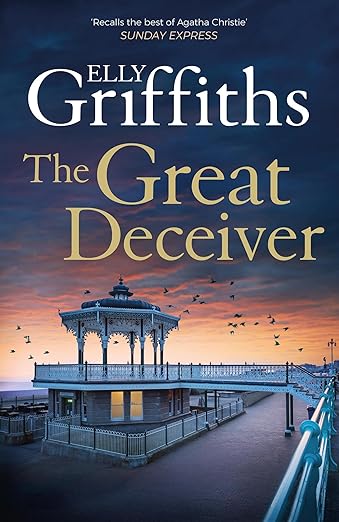
The Great Deceiver by Elly Griffiths – book 7 of 7 in the Brighton Mysteries
Magician Max Mephisto, now divorced and living in London, is on his way to visit daughter Ruby and her new-born baby when he is hailed by a voice from the past, fellow performer Ted English, aka the Great Deceiver. Ted’s assistant, Cherry, has been found dead in her Brighton boarding house and he’s convinced that he’ll be accused of her murder.
Max agrees to talk to his friend, Superintendent Edgar Stephens, who is investigating the case. What Max doesn’t know is that the girl’s family have hired private detective duo Emma Holmes (aka Mrs Stephens) and Sam Collins to do some digging of their own.
The inhabitants of the boarding house, most of whom are performing in an Old Time Music Hall show on Brighton pier, are a motley crew. The house is also connected to a sinister radio personality called Pal. When a second magician’s assistant is killed, Edgar suspects a serial killer. He persuades Max to come out of semi-retirement and take part in a summer show. But who can pose as his assistant? Edgar shocks the team by recommending someone close. . .











 BooksPlease