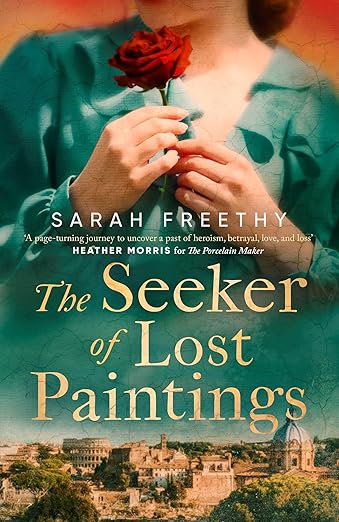
Simon & Schuster UK| 11 September 2025| 400 pages| e-book| Review copy| 5*
Blurb:
Rome 1939
Arriving in Rome to work for the wealthy Montefalco family, Maddalena is homesick and alone. She finds solace – and love – in the beauty of the city, but as the war in Nazi-occupied Italy rages, she must make a devastating choice.
London, 1997
After her mother Maddalena’s death, Beatrice Fremont discovers a fragment of a painting and a letter that sends her on a hunt to Rome. Helping her is art dealer Jude Adler, who’s convinced they are looking for a lost Caravaggio. For Jude, this could be the find of a lifetime; but for Beatrice their search uncovers a shocking secret and the answer to a mystery kept hidden for years.
I’ve not read Sarah Freethy’s first novel, so I wasn’t sure what to expect from her latest book, The Seeker of Lost Paintings. I am delighted to say I loved it. It’s historical fiction set in two timelines, one in the 1940s in Italy and the other in 1997 in London and Italy. It appealed to me because of the mystery surrounding a lost Carravagio and I really enjoyed that aspect. I’ve read quite a lot of historical fiction set during the Second World War, but I don’t think I’ve read any set in Italy during the Nazi occupation before and it was this part of the story that I enjoyed the most.
The book begins with a Prologue set in Naples in 1610 with an unnamed artist as he starts a painting. Who he is and what he is painting only becomes clear later in the book. The narrative then flies forward to July 1997 and a hot day in London when Beatrice Fremont, yearning to be in Italy where both of her parents were born, is waiting for Jude Adler to arrive to value her late father’s art and photography collections. Her mother, Maddalena is seriously ill and they need to sell his collections to secure the family home.
When Jude spots a small painting, hanging on Maddalena’s bedroom wall, he is convinced he’d seen the image somewhere before. It reminds him of Caravaggio’s painting of St John the Baptist in Youth with a Ram. Caravaggio’s followers had made many copies of that painting and Jude is convinced that if it is one of those it could be worth tens of thousands. But Maddalena wants Beatrice to reunite the painting with its rightful owner. And so after Maddalena’s death, the search to find out more about the painting begins, taking Beatrice and Jude to Italy.
Back in 1939, Maddalena was working as a cook at the home of Conte Luca Montefalco, at the Villa Velare in Rome. Luca’s older brother Roberto had renounced his title and taken up Holy Orders, and is working at the Vatican where he is responsible for an art collection that must be preserved and removed from the Vatican in preparation for the impending war. It was a remarkably tense and difficult time in Italy, under Mussolini and the Fascists, and the local people suffered immensely under the Nazi occupation.
Sarah Freethy’s beautiful descriptive writing and characterisation transported me back to that period, almost as though I was there witnessing what life was like for the ordinary Italians during the war years – the dangers and privations they faced. It really is a remarkable book, drawing together the two strands of the story, both in the past and the present and ending in a satisfying conclusion.
Many thanks to the publishers, via Netgalley for my review copy and I’d love to read more of Sarah Freethy’s books.







 BooksPlease