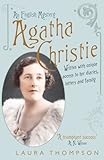
It took me weeks to read Laura Thompson’s book Agatha Christie: An English Mystery. It has taken me several days to write and re-write this post because I’ve found it difficult to put down my thoughts about it without going into too much detail (and this is still a long post). My overall impression of the book is that I felt as though I was intruding into Agatha Christie’s private life that she had not wanted to be made known. I also think that Laura Thompson had found it difficult to separate the woman from her writing, because throughout the book facts are interspersed with suppositions drawn from Agatha Christie’s novels and in particular from Unfinished Portrait, a novel Agatha wrote under the pseudonym, Mary Westmacott.
Agatha Christie: An English Mystery is described as a ‘perceptive and stylish biography‘ on the jacket sleeve, but it is not just a biography; it is also a study of Agatha Christie’s novels, drawing conclusions from her writing about her thoughts, feelings and emotions and a fictionalised version of Agatha’s disappearance in 1926. Laura Thompson’s sources are unpublished letters, papers and notebooks.
First of all, concerning the study of the novels I was dismayed as I was reading this book at the amount of information she reveals about the crime fiction novels, including giving away who the murderers are in a number of cases. Charles Osborne’s book The Life and Crimes of Agatha Christie is much better, outlining the books, not just her crime novels but also her non-fiction, stories for children, poetry and plays in chronological order and nowhere does he reveal the identity of any of the murderers.
Then the fictionalised version of Agatha’s disappearance is in a chapter called ‘The Quarry‘, which begins ‘Time for a new story‘, words which did not immediately alert me that Laura Thompson was no longer writing strictly from the sources at her disposal but also from her imagination, putting words into Agatha Christie’s mouth that she could not have known, and describing her reactions to the people she met and the newspaper reports of her disappearance. Later in this chapter she wrote:
All biography is story-telling. No life is a code to be deciphered: there will always be gaps and inconsistencies, and it is stories that make the missing connections. Omniscience is for Hercule Poirot. Real life knows less; it has the beauty of mystery; and this, despite the books she wrote, was something that Agatha understood very well. She must have known she had created a puzzle of a different order, with all the geometric complexity of ‘Roger Ackroyd’ – and how to work it out? Turn it this way? That way? – and yet the twist in the tale: it was true, and therefore it could never be solved. It was perfect in fact. The perfect metaphor for human mystery. What could be more impenetrable than the woman who moved through Harrogate like a smiling ghost, reading newspaper reports about her own vanished self? (page 219)
I just wish she had not gone so far down the story-telling line in this book and had left this episode of Agatha Christie’s life as an impenetrable mystery, or at least had made it clear straight away when she was writing imaginatively. I have absolutely no objections to fictionalised versions of a life (for example I really liked Justine Picardie’s book Daphne: a novel, which merges fact and fiction) but I do think it should be obvious that it is fictionalised. Nor do I object to different interpretations of
Laura Thompson quotes from Unfinished Portrait, using this as evidence of Agatha’s thoughts, beliefs, and emotions. In Osborne’s book he also states that Unfinished Portrait, which was published in 1934, is based on events in Agatha’s life:
The story of Celia is remarkably similar to the story of Agatha as readers were eventually to be offered it in ‘An Autobiography’ more than forty years later. Several incidents are common to ‘An Autobiography’ and ‘Unfinished Portrait’, and the novel is quite clearly a fictionalised, more detailed, and emotionally more forthcoming version of the first third of the biography. The portraits of Celia’s mother and her grandmother are really of young Agatha Miller’s mother and the grandmother with who she stayed in Ealing. The men in Celia’s life are the men in Agatha’s life, and Dermot, whom Celia marries, is Archie Christie. (page 105)
but he also quotes from Max Mallowan’s writings about the book, pointing out it is a blend of fact and fiction:
The book is not one of her best because, exceptionally, it is a blend of real people and events with imagination. Only the initiated can know how much actual history is contained therein, but in Celia we have more nearly than anywhere else a portrait of Agatha. (page 106 of ‘The Life and Crimes of Agatha Christie’)
It is evident that Agatha Christie wrote about things she knew – the use of poisons from her work in a pharmacy during the First World War and her journey on the Orient Express are just two examples. Laura Thompson later in the book acknowledges that it is impossible to know what Agatha really thought – this is in the chapter called ‘The Second Husband‘, (page 298) writing about Agatha’s reaction to the Woolleys’ interference with her honeymoon with Max Mallowan. And she acknowledges that it would not have occurred to Agatha Christie that conclusions about her character would be drawn from her remarks in the novels about Jews, ‘blacks’ and servants, so I think it is difficult to decide what inferences can be drawn about Agatha from her fiction!
The last sections of Thompson’s book deal in detail with Agatha Christie’s tax problems and there is a rather ‘gossipy’ section about whether or not Max was having affairs. Overall, I think that the book as a biography is unbalanced, concentrating on the events surrounding Agatha’s disappearance and there is much speculation and supposition. I prefer Agatha’s own version of her life: An Autobiography, in which she merely referred to the events of 1926 thus:
The next year of my life is one I hate recalling. As so often in life, when one thing goes wrong, everything goes wrong. (page 356)
Finally, if biography is ‘story-telling’, about making connections to fill in the missing gaps with stories, then I’m not sure I want to read it and there have been several times when reading this book that I’ve thought about abandoning it. I’m uncomfortable with the feelings it can provoke – disliking gossip, distrusting witnesses who may have a private agenda, and squeamishness about reading private correspondence. I felt all of this whilst reading this book.
I went back to a book I read a few years ago – Hermione Lee’s book Body Parts: Essays on Life-Writing.This is about writing biography and the relationship of biography to fiction and history. Lee writes that biographies must give a ‘quasi-fictional, story-like shape to their material (or no none will read them)’, but against this there is the ‘responsibility for likeness and the need for accuracy’.Gaps and silences give rise to interpretations ‘through a process of conjecture, invention, intuition and manipulation of the evidence.’ Biography may seem as if it is factual because it is constructed from sources such as letters, diaries and other people’s accounts, etc but it is inevitably an interpretation and quasi-fictional. I have to remember that – it’s a reading between the lines! And as Lee says:
Whether we think of biography as more like history or more like fiction, what we want is a vivid sense of the person.
…
What makes biography so curious and endlessly absorbing is that through all the documents and letters, the context and the witnesses, the conflicting opinions and the evidence of work, we keep catching sight of a real body, a physical life: the young Dickens coming quickly out of a room, sprightly, long-haired, bright-eyed, dandyish, in crimson velvet waistcoat or tartan trousers …
As I read Laura Thompson’s book I did catch glimpses of Agatha Christie, but they were rather swamped by inferences drawn from her books, by the fictionalised version of her disappearance and by the descriptions of her tax problems towards the end of her life. I felt closer to the real Agatha Christie whilst reading her Autobiography. As well as being a record of her life as she remembered it and wanted to relate it, it’s also full of her thoughts on life and writing and in particular about her love of life and the joy of being alive.
But I will carry on reading biographies!
 The Tea and Books Challenge was to read Books over 650 pages. I was aiming to read 4 Books for the Berry Tea Devotee Level.
 levels to aim for. I nearly made it to Elementary School:


 Searching for the Secret River
 BooksPlease